

NVIDIA RTX Spark: Windows on Arm’s Most Important Test Yet
For as long as anyone in the enthusiast space can remember, gaming on a Windows laptop has involved significant compromises, especially in battery life. The thin machines were strictly for office work and light travel, while the high-performance rigs required a massive power brick and a wall outlet to unleash their true silicon potential.
Enter NVIDIA RTX Spark. This is NVIDIA’s aggressive bid to bring RTX graphics, CUDA, DLSS, Reflex, TensorRT, unified memory, local AI, and genuine game support into a single, unified ecosystem. If NVIDIA can pull this off, RTX Spark could easily become the most critical Windows on Arm launch to date.
A Coordinated Push Into Windows on Arm
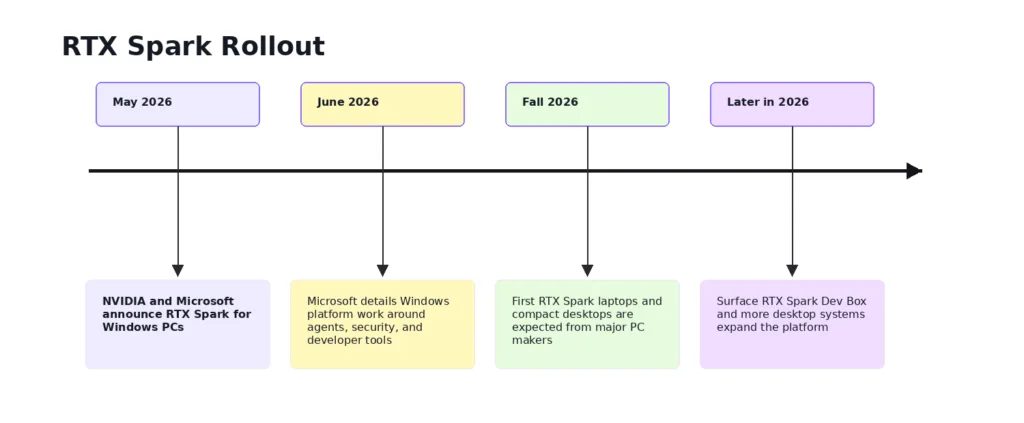
RTX Spark matters because NVIDIA isn’t treating Windows on Arm as a mere side project. According to NVIDIA, RTX Spark systems are slated to arrive this fall from a massive roster of OEMs: ASUS, Dell, HP, Lenovo, Microsoft Surface, and MSI, with Acer and GIGABYTE following shortly after.
This goes far beyond a standard chip announcement. It represents a deeply coordinated push across silicon, Windows OS, Surface hardware, and tier-one PC makers simultaneously. While Windows on Arm has seen launches before, very few have hit the ground running with this level of serious industry backing.
Microsoft is leaning heavily into the platform. The company has already tied RTX Spark directly to its Surface Laptop Ultra and a dedicated Surface RTX Spark Dev Box. Instead of waiting for third-party PC makers to figure out the form factor, Microsoft is putting its own premium hardware behind the platform.
The first wave of systems makes this launch feel tangible, moving past the usual concept demos. Microsoft points to high-end devices like the:
- XPS 16 Creator Edition
- HP OmniBook Ultra 16
- HP OmniBook X 14
- Lenovo Yoga Pro 9n
- MSI Prestige N16 Flip AI Plus
This represents a massive shift in positioning. RTX Spark is not marketed as a budget-efficiency chip; it is squarely aimed at premium Windows laptops and compact PCs designed for creators, developers, power users, and gamers.

Under the Hood: A Different Kind of AI PC Chip
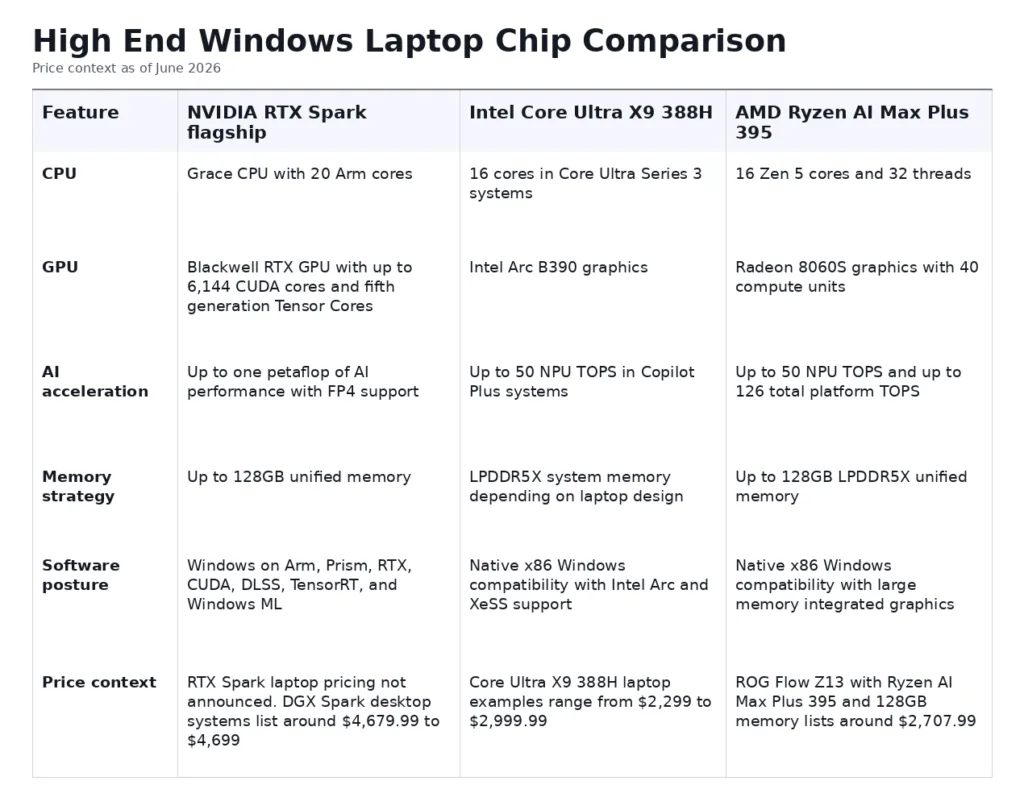
The most crucial takeaway is that RTX Spark is not simply an Arm CPU with a bolted-on NPU. NVIDIA claims the platform combines a robust set of silicon:
- A Grace CPU with 20 cores
- A Blackwell RTX GPU packing 6,144 CUDA cores
- Fifth-generation Tensor Cores
- NVLink C2C
- Up to 128GB of unified memory
That pitch is significantly larger than the standard “AI PC” narrative currently dominating the market. While most AI PC launches fixate on an arbitrary NPU count, Copilot integration, or a webcam-blurring demo, NVIDIA is focusing on the heavy-hitting technologies enthusiasts actually care about: CUDA, RTX, DLSS, Reflex, TensorRT, OptiX, and G-SYNC.
The unified memory architecture is a game-changer. With up to 128GB of shared memory, the CPU and GPU can access the same massive pool, bypassing the traditional latency and capacity limits of split system/graphics memory. This is vital for local AI model deployment, massive 3D creative projects, and severe multitasking.
NVIDIA states that RTX Spark can easily handle demanding workloads like massive 3D scenes, high-resolution video editing, local AI, and RTX gaming. While these remain company claims for now, the target demographic is crystal clear: NVIDIA wants RTX Spark to operate less like a mobile chip and more like a compact, portable workstation.
To support this, Microsoft is tuning the OS around the silicon. Windows has reportedly been optimized for scheduling, power management, thermals, DirectX 12, neural rendering, and native TensorRT access through Windows ML.
Bringing RTX Gaming to Windows on Arm
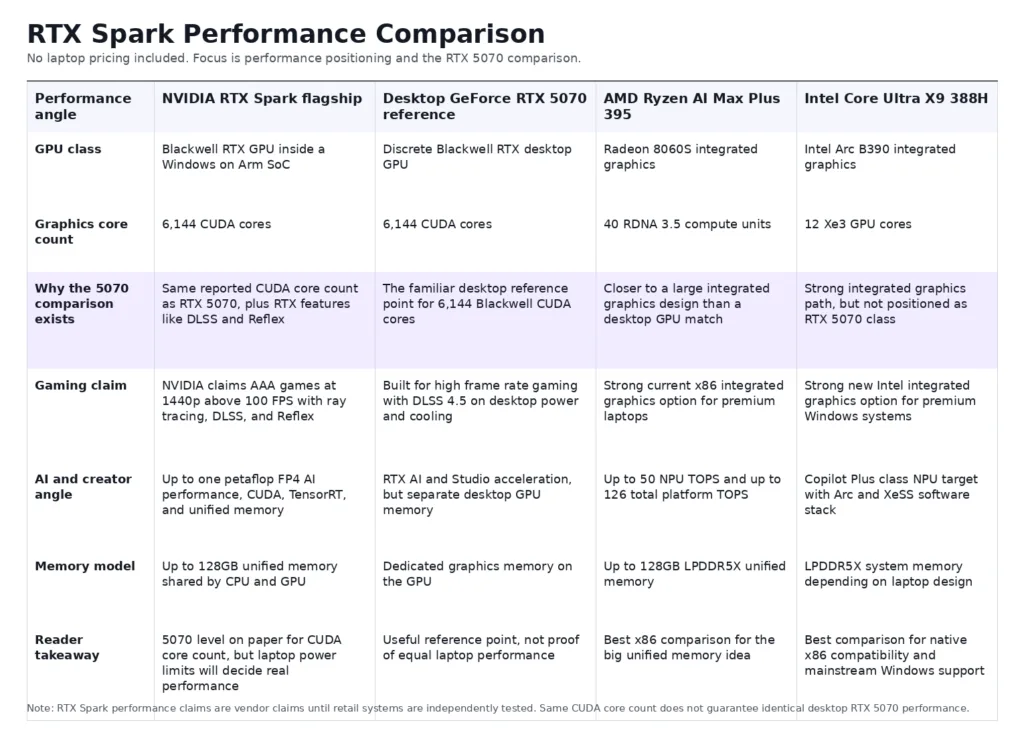
Gaming will be the ultimate trial by fire for RTX Spark. NVIDIA boldly claims the platform is built to handle 1440p gaming at over 100 frames per second, complete with ray tracing, DLSS, and Reflex.
This is a massive claim for a Windows on Arm laptop. It clearly signals that this isn’t just an “all-day battery for spreadsheets” pitch; NVIDIA demands that hardcore gamers take Windows on Arm seriously.
The inclusion of the gaming stack is what differentiates this from past Arm efforts. RTX Spark crams familiar NVIDIA features—DLSS, Reflex, ray tracing, and next-gen Blackwell graphics—into thinner, more efficient form factors than traditional heavy gaming laptops.
The massive hurdle, of course, is compatibility. Microsoft states that RTX Spark will launch with vital support for:
- Epic Easy Anti-Cheat
- BattlEye
- Expanded Prism compatibility
- The Xbox PC app
Early compatibility targets include heavy hitters like League of Legends, VALORANT, PUBG Battlegrounds, Alan Wake 2, Naraka Bladepoint, Pragmata, and War Thunder. This level of support is critical because PC gaming routinely breaks where normal applications do not. Games rely heavily on launchers, overlays, kernel-level anti-cheat, capture utilities, mods, and intricate driver behaviors. A laptop can feature incredible silicon, but if those software layers fail, the machine feels broken.
If RTX Spark can successfully make AAA games feel native on Windows on Arm, it redefines the entire category. The platform needs rigorous retail testing to verify frame pacing, emulation performance, thermals, and fan noise. Manufacturer demos are one thing, but the enthusiast community won’t buy in until retail silicon proves itself.
The Emulation Hurdle: Windows on Arm Must Prove Itself
Windows on Arm is undeniably in a better state than it was a year ago. Microsoft notes that Windows 11 on Arm can emulate x86 and x64 apps, and the Prism update in Windows 11 24H2 significantly improves performance while lowering CPU overhead during emulation.
Furthermore, Microsoft confirms that Prism has been specifically tuned for RTX Spark. For standard desktop applications, this should make the user experience feel far less experimental than previous generations.
The catch? Emulation isn’t a magic bullet. Microsoft’s documentation explicitly states that emulation only supports code running in user mode. Drivers and components operating in kernel mode still require native Arm64 support.
This is where PC gaming gets messy. Audio interfaces, capture cards, older VST plugins, enterprise tools, and obscure peripheral software can easily throw a wrench in the gears.
However, Microsoft is providing a smoother path for developers. Arm64EC allows software makers to port code to native Arm support iteratively, rather than rebuilding massive applications from scratch. App support has visibly expanded across creative and developer tools.
Taking Aim at Apple Silicon
The most obvious comparison here is Apple Silicon—not because Windows on Arm has definitively solved its software woes, but because the foundational pitch is now identical.
RTX Spark is built on an Arm-based design, features unified memory, promises massive performance per watt, targets thin, premium chassis, and caters to local AI and serious creator workloads. That is the exact narrative Apple has used to dominate the MacBook Pro for years. Apple successfully proved that an ARM laptop can be thin, silent, and incredibly fast, shifting consumer expectations away from laptops that only perform well when tethered to a wall.
NVIDIA and Microsoft are countering with a distinct arsenal. While Apple boasts macOS integration and years of Arm momentum, NVIDIA counters with CUDA, TensorRT, RTX, DLSS, Reflex, and a vast Windows gaming ecosystem that Apple simply cannot match.
This gives Windows on Arm a compelling new argument. If compatibility is rough or thermals get ugly, RTX Spark will feel ambitious but unfinished. But if NVIDIA delivers, this could be the first Windows on Arm launch that actually matters to gamers, creators, and developers.
It doesn’t need to defeat Apple Silicon in every benchmark on day one. It just needs to prove that Windows on Arm is finally ready for the heavy lifting. The real verdict starts when the laptops ship this fall.