

This editor has been to many CES shows including the very first in Las Vegas, in 1978. CES (Consumer Electronics Show) is the world’s biggest annual tech trade show. This year nearly 150,000 attendees, including 6,900 media members, joined over 4,100 exhibitors at the show where major companies and startups revealed groundbreaking consumer electronics, future tech trends, and next-generation gadgets on the floors of the Las Vegas Convention Center.
However, this editor skipped the LVCC entirely to attend prearranged meetings with eight companies — AMD, CORSAIR, Dell, HP, Intel, Lenovo, MSI, and NVIDIA. These meetings were held at four resorts, which are part of the official CES ecosystem of campuses where the real business of CES mostly takes place. This report is about those meetings.
AMD
We met with David McAfee, corporate VP and general manager, Client Channel Business in the Venetian Hotel resort. Most of the discussion was about servers. In her keynote, Dr. Lisa Su teased AMD’s next-generation of AI accelerators. She boasted that the MI500 series, releasing next year, will deliver a 1,000x uplift in performance over its two-year-old MI300X GPUs as a blueprint for yotta-scale AI infrastructure, built on AMD Instinct MI455X GPUs and AMD EPYC Venice CPUs.
The Helios rack’s 72 GPUs expect to deliver 2.9 exaFLOPS of dense FP4 performance, 1.4 exaFLOPS at FP8, 31 TB of HBM4, and 1.4 PB/s of memory bandwidth to compete directly with NVIDIA’s announced Vera Rubin NVL72 rack systems. AMD will also offer the MI440X in a much smaller eight-way configuration to compete with NVIDIA’s Rubin NVL8 racks.
In addition, MI430X GPUs will power AI factory supercomputers around the world, including Discovery at Oak Ridge National Laboratory and the Alice Recoque system, France’s first exascale supercomputer.
AMD’s hardware has always been top-notch but they have often left their open-source software development to their partners with inconsistent results. Over the past three years, we have noted that AMD has put a lot more effort into delivering what they promise, especially with regard to the AMD ROCm software ecosystem, so as to ultimately directly compete with NVIDIA and CUDA.
For consumers and devs, AMD introduced the AMD Software: Adrenalin Edition AI Bundles; software to simplify the setup for running local AI applications to make it more easily accessible.
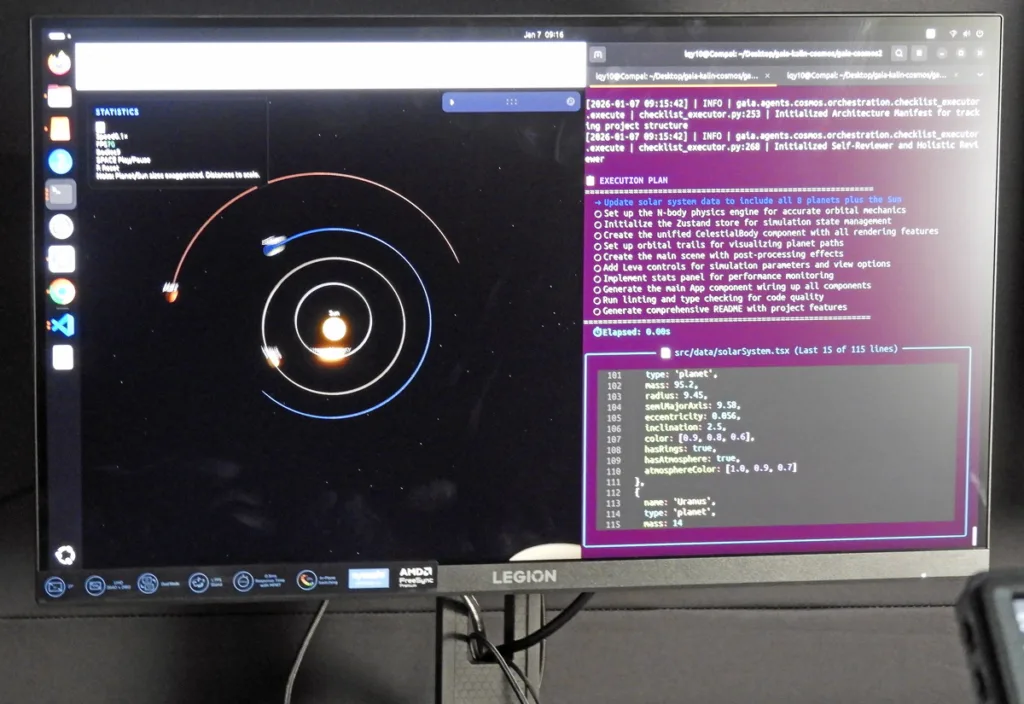
AMD concentrated on “AI everywhere” and consumer hardware was somewhat neglected. The upcoming launch of the “new fastest gaming processor”, the 9850X3D, was not mentioned in the keynote, and it barely touched on the new Ryzen AI 400 “Gorgon Point chips
AMD’s upcoming Ryzen AI 400 series of Gorgon Point notebook and desktop APUs will arrive in Q1 2026 as a speed bump/refresh of their current Strix Point chips with an improved XDNA 2 NPU. In addition, AMD announced the first Copilot+ desktop processor, as well as two new entries in its Strix Halo lineup that use fewer CPU cores; Ryzen AI Max+ 392 (12-core) and 388 (8-core) models. They will use 40 graphic compute units (CUs), and will be ideal for gaming handhelds and notebooks; they will most likely beat Intel’s new Panther Lake Arc B390’s iGPU with 12 Xe cores although at a cost of a higher power draw.
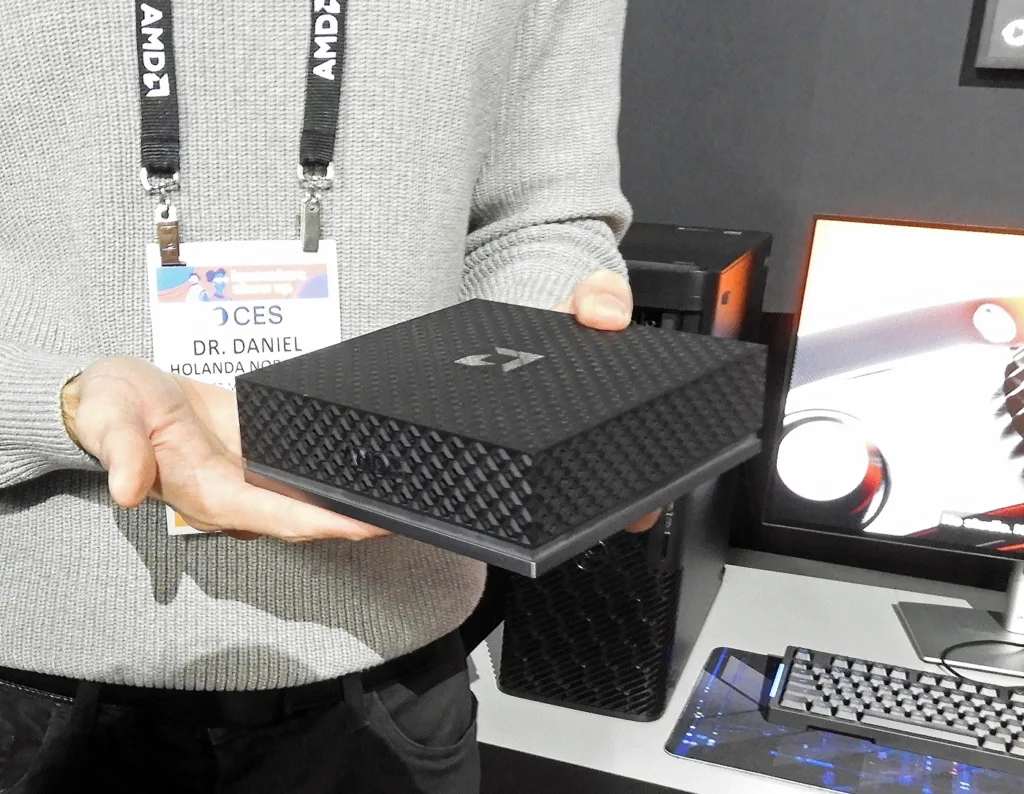
AMD also announced their competitor to NVIDIA’s DGX Spark, the Ryzen AI Halo, which we are able to view. As what is basically a development kit, it promises optimized applications and AI models across Windows and Linux with full AMD ROCm out-of-the-box support for leading AI models. It’s powered by the Ryzen AI Max+ 395 with up to 128GB unified memory and an integrated NPU for running large generative AI models.
As we continue to work with and develop custom AI benchmarks, we hope to be able to review for our readers the Ryzen AI Halo, along with the new Strix Halo and Gorgon Point APUs. We also will continue to cover gaming and hope to review the new Ryzen 7 9850X3D.
CORSAIR
We met with our contacts at CORSAIR and were privileged to meet their CEO, Thi La. CORSAIR makes a wide range of high-performance PC components and gaming peripherals, including RAM, PSUs, cases, cooling solutions, SSDs, gaming keyboards, mice, headsets, monitors, streaming equipment, professional workstations, and the AI PC workstation featured at CES which we already reviewed.
CORSAIR has also adopted AI into its PC lineup with a strong emphasis on practicality and the use of local models instead of using the cloud. Using a local model gives the user complete privacy instead of being datamined by the cloud providers. The image below of this editor was generated in just a few seconds by a model running on a local PC.
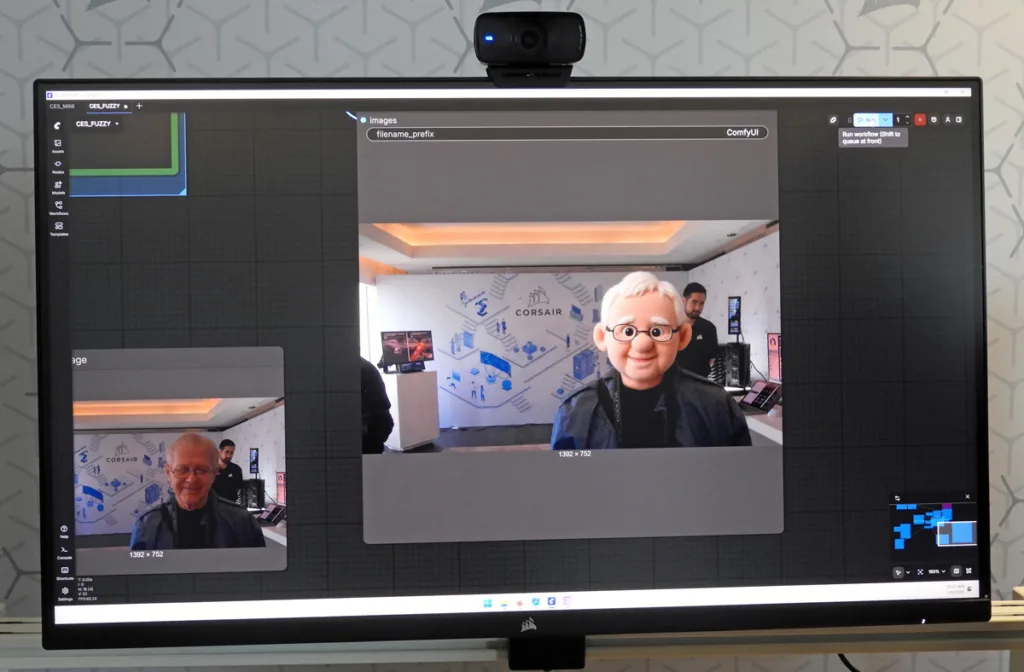
Of course, AI is not just for cat pictures or silly images. CORSAIR primarily caters to gamers, content creators, and PC enthusiasts. iCUE is Corsair’s unified software platform for customizing RGB lighting, monitoring PC performance, and controlling compatible CORSAIR hardware from a single interface.
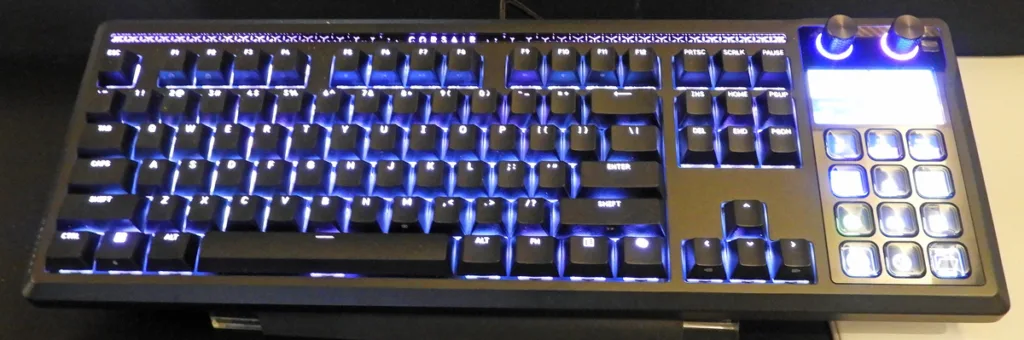
The GALLEON 100 SD is the winner of a CES 2026 Innovation Award. It combines a full-size mechanical gaming keyboard with an integrated Stream Deck which brings gameplay commands, streaming tools, and system controls together by using tactile controls or screen overlay buttons.
Stream Deck integrates with apps and tools like Spotify, voice chat, and peripheral management without pausing or alt-tabbing. System performance, battery life, and mic level adjustment monitoring are just a small subset of the hundreds of plugins available on the Elgato Marketplace to give gamers access to whatever they need. Currently in beta, Model Context Protocol (MCP), allows the Stream Deck to interface with AI agents and software workflows by using voice commands.
CORSAIR has also been working with NVIDIA to make AI practical for gamers with iCUE plus NVIDIA’s G-ASSIST to understand a gamer’s PC, optimize performance, and help improve their gaming during game sessions.
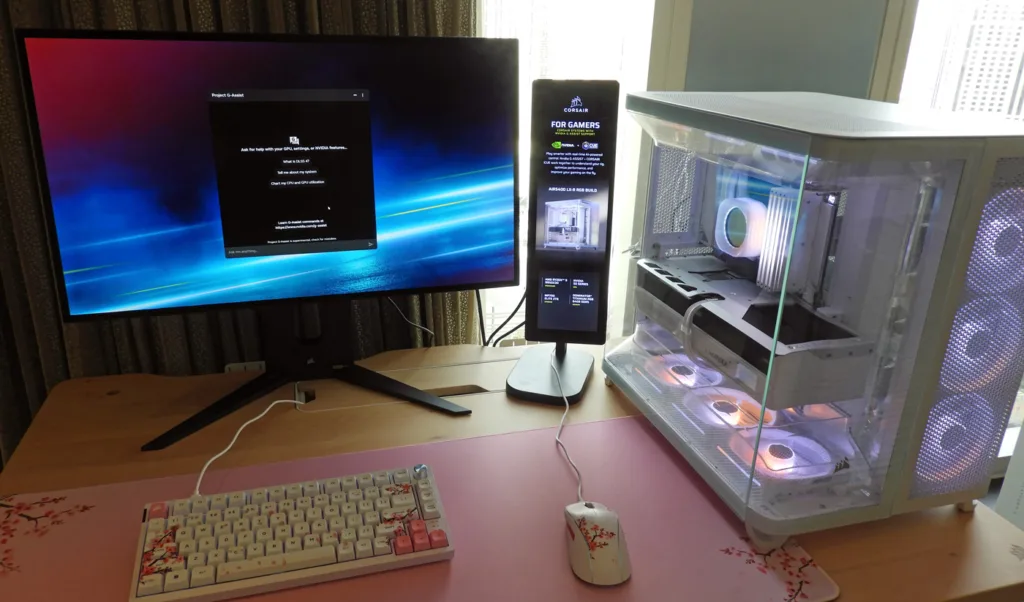
Similarly to this, currently by using cloud AI — and eventually becoming local — CORSAIR uses Elgato for creators to unify lighting, audio, and control into a simplified workflow controlled by voice as the following video demonstrates.
Sim users, including VR simmers, have long depended on Fanatec peripherials for realism. CORSAIR officially acquired Fanatec in late 2024 to expand their presence in the sim racing market.
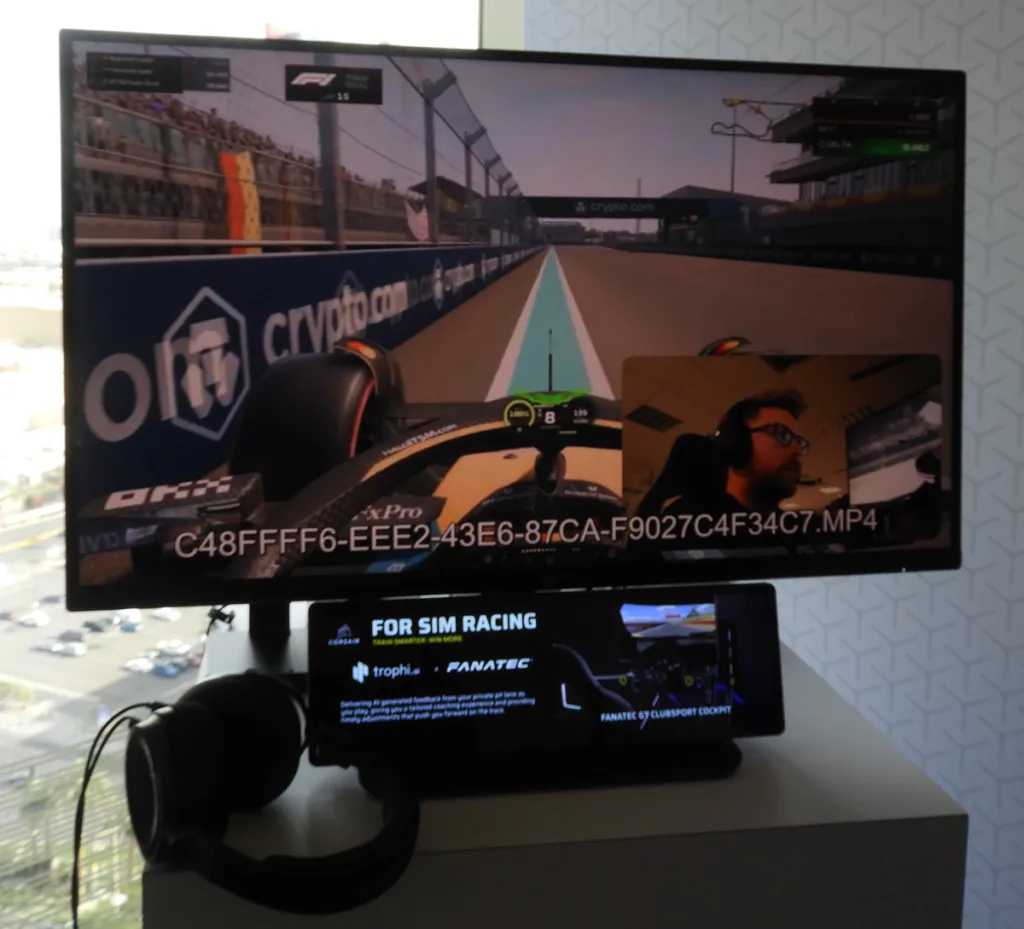
Fanatec integrates AI by using the Fanatec App, partnering with AI coaching services to offer real time AI-driven driving analysis and suggestions, personalized feedback, and smarter virtual opponents within multiple sim racing games.
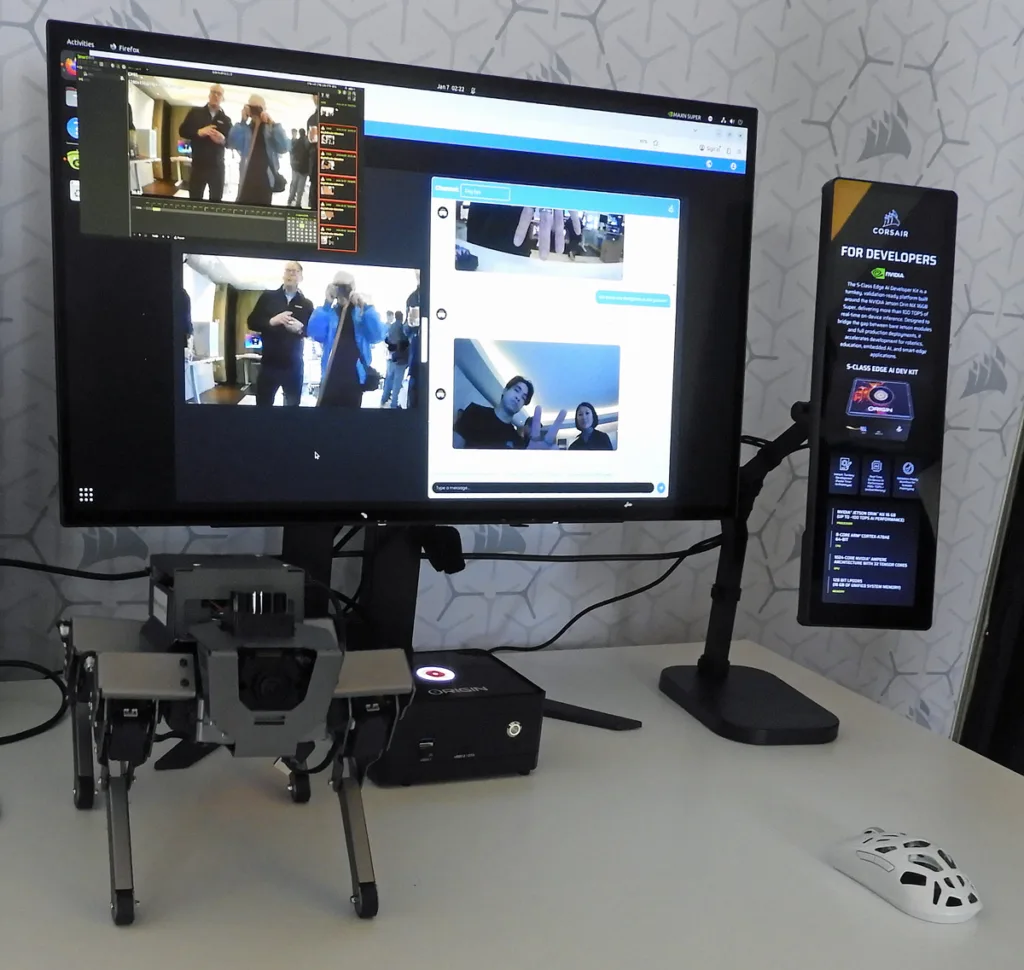
CORSAIR also owns ORIGIN PC and has just announced the S-Class Edge AI dev kit. It’s a compact developer kit built around the NVIDIA Jetson Orin NX 16GB Super. The platform is designed for developers, researchers, and integrators who need a ready-to-use environment for robotics, computer vision, and edge AI workloads, delivering up to 157 TOPS of performance.
Got $100,000 to $150,000+ to spend on a workstation? CORSAIR has you covered with the upcoming X-Class Grando.
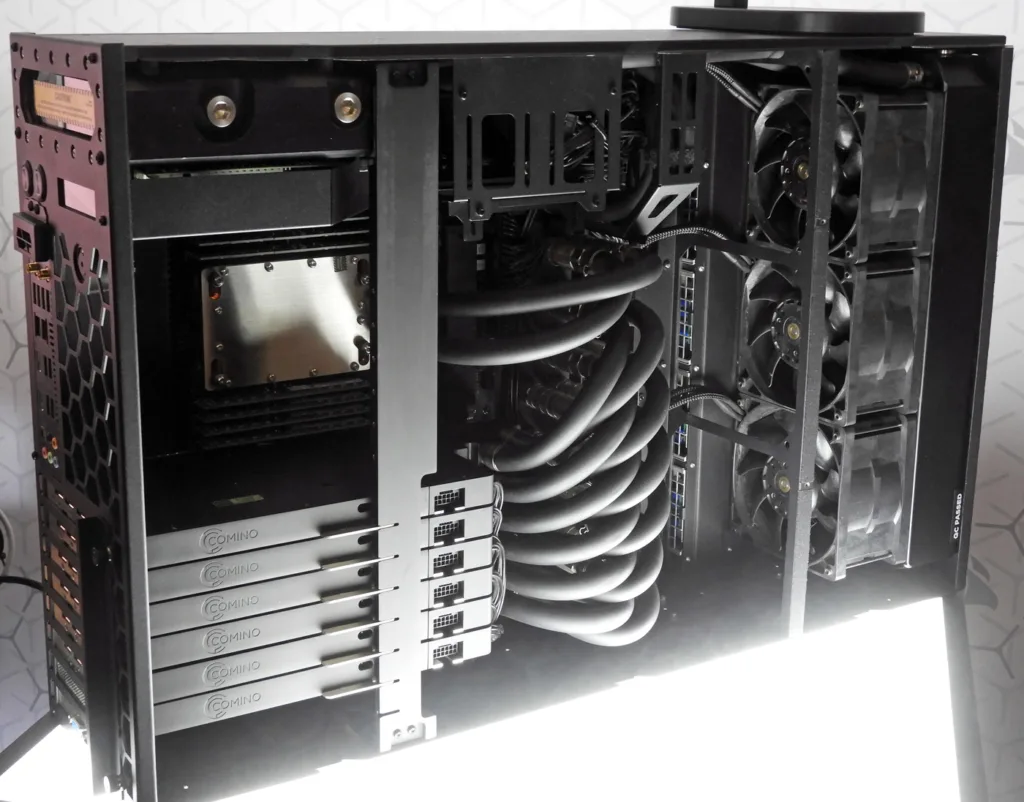
This amazing liquid cooled workstation which is not yet ready for sale, features multiple NVIDIA Grace Superchips and up to six Pro 6000 Blackwell GPUs. If you’d rather not wait, you can currently configure an X-Class GRANDO from ORIGIN PC with a Threadripper Pro, 1TB of ECC DRAM, 32TB of NVMe M.2 Storage, and six A1000s, all powered by up to four 1600W PSUs.
Several new gaming mouse devices and a new mechanical keyboard were also showcased. We hope to bring you reviews of some of these exciting new CORSAIR products soon.
Dell
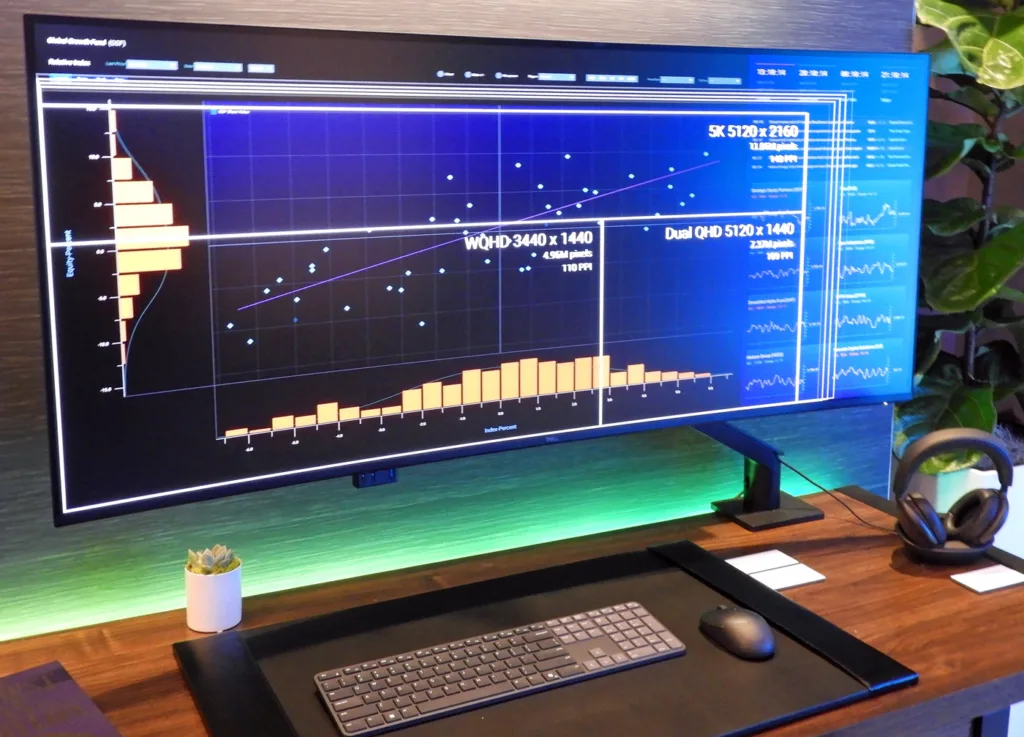
The Dell UltraSharp 52 Thunderbolt Hub Monitor is the world’s first 52-inch 6K monitor. Designed to be easy on the eyes, it achieves tier 6 of TÜV Rheinland Low Blue Light certification. Although it can be used for gaming, it’s primarily designed for financial traders, data scientists, engineers, and executives who require a super-wide screen without resorting to a multi-monitor setup.
In addition, the commercial display Dell UltraSharp 32 4K OLED monitor features DisplayHDR 500 QD-OLED with Anti-Glare reflectance. It’s for creative professionals who demand ultra-high precision color accuracy, and it will be available by the end of next month.
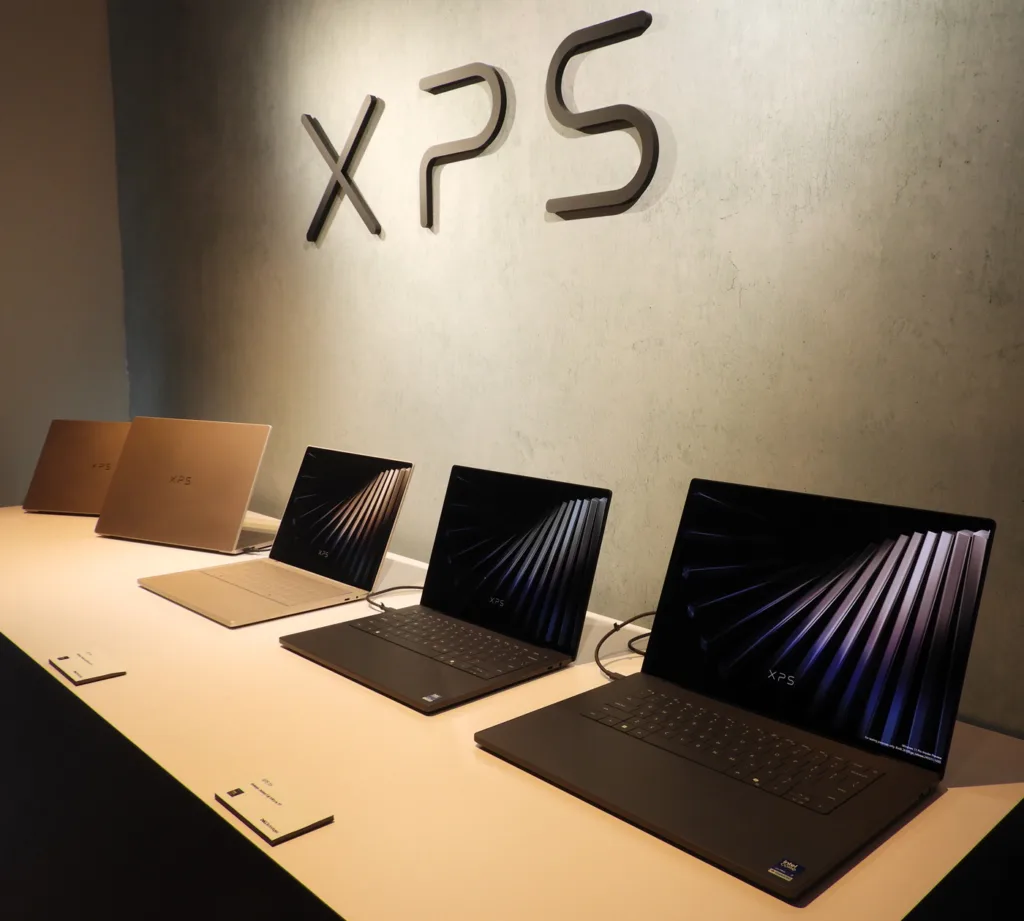
XPS is back, lighter, and with a new streamlined design as Dell’s thinnest model lineup.
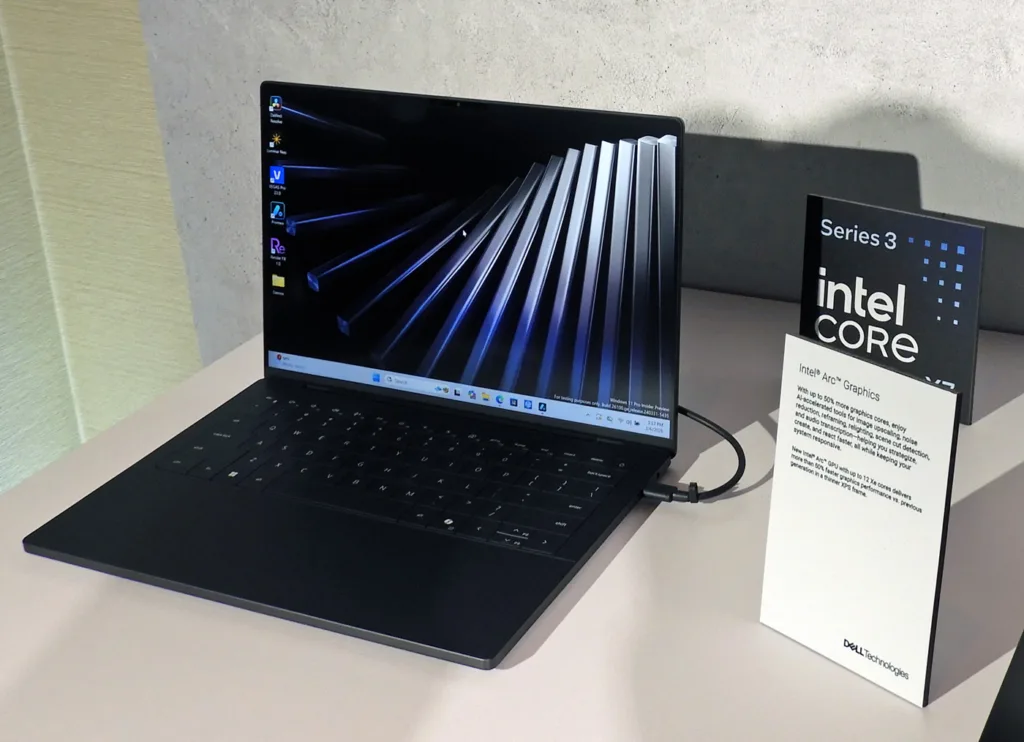
The XPS 14 weighs 3 pounds while the flagship XPS 16 weighs only 3.6 pounds, almost a full pound lighter than its predecessor. They are available with tandem OLED display options powered by Intel Core Ultra Series 3 processors with integrated Arc graphics featuring 12 Xe cores.
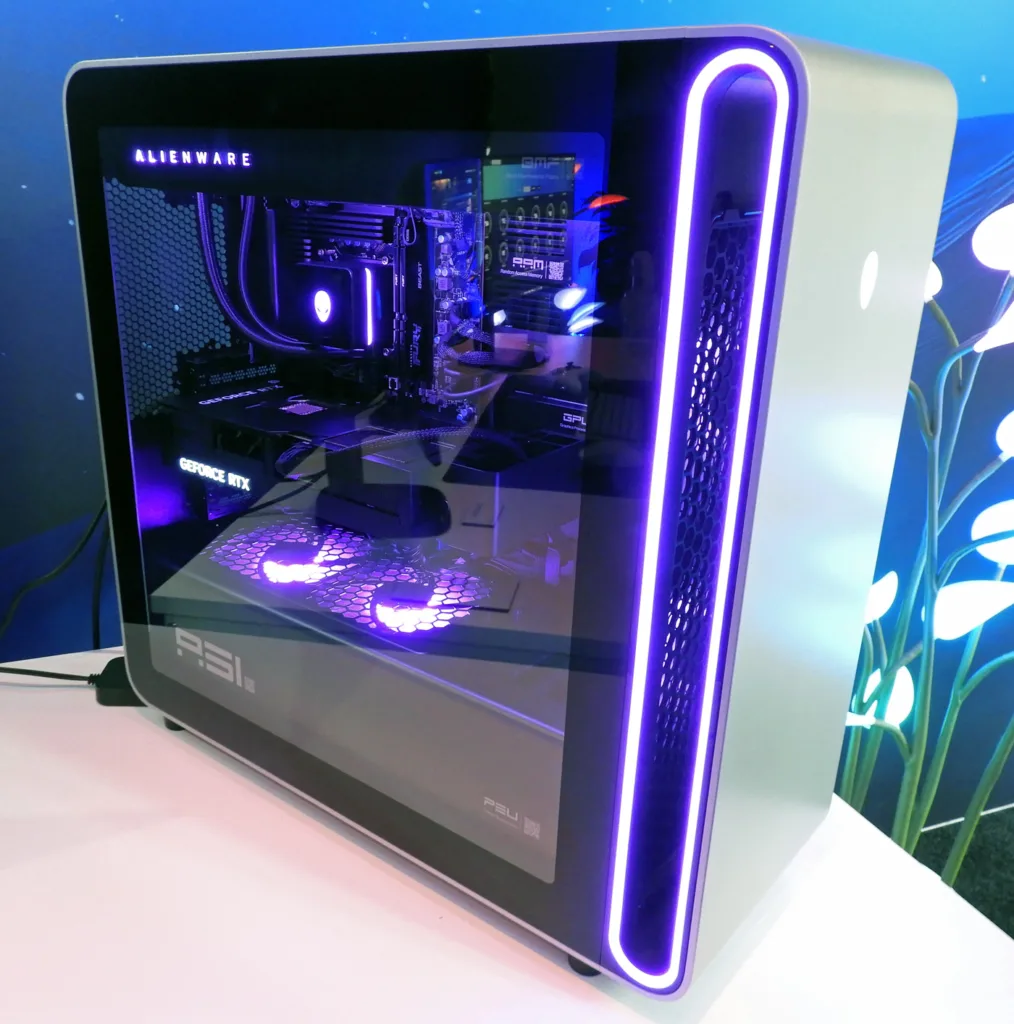
Alienware was prominently featured with the highly configurable Area-51 desktop which now features the Ryzen 7 9850X3D – expected to be the world’s fastest gaming CPU – and will be available later this month.
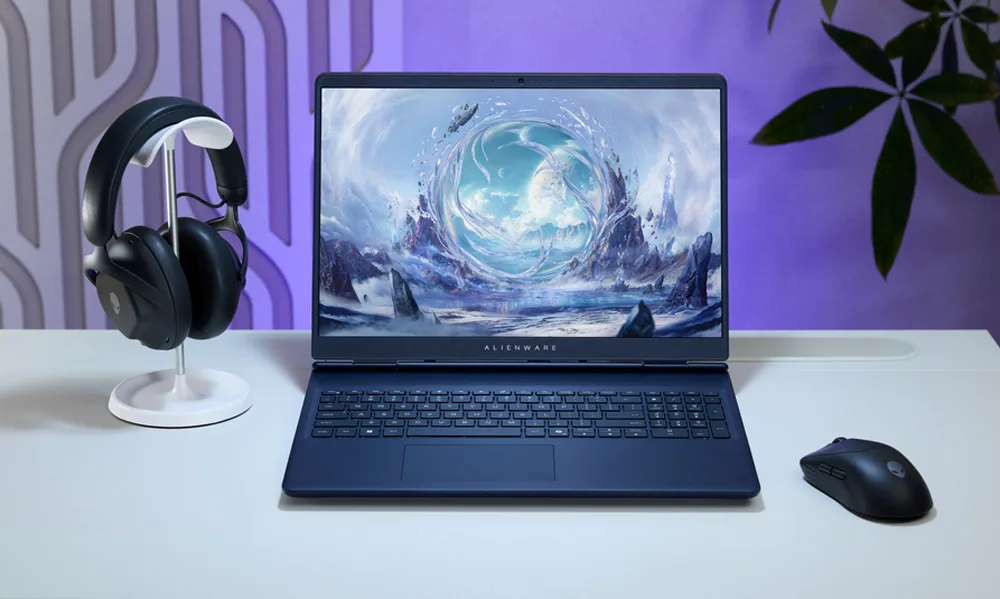
Alienware gaming notebooks were also featured and the 16″ Area-51 was displayed featuring a 240Hz OLED screen powered by Intel Core Ultra HX200 CPUs.
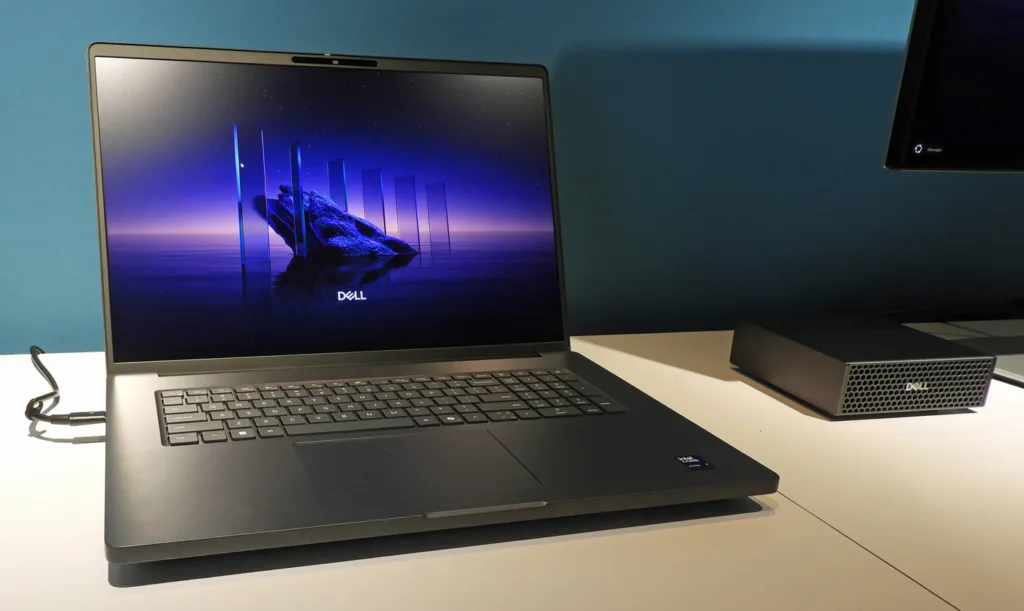
Although not new to CES 2026, multiple workstation models were featured including the Dell Pro Max 18 Plus notebook and the mini GB10 featuring the NVIDIA GB10 Grace CPU (10 Cortex-X925 + 10 Cortex-A725 cores) and Blackwell GB10.
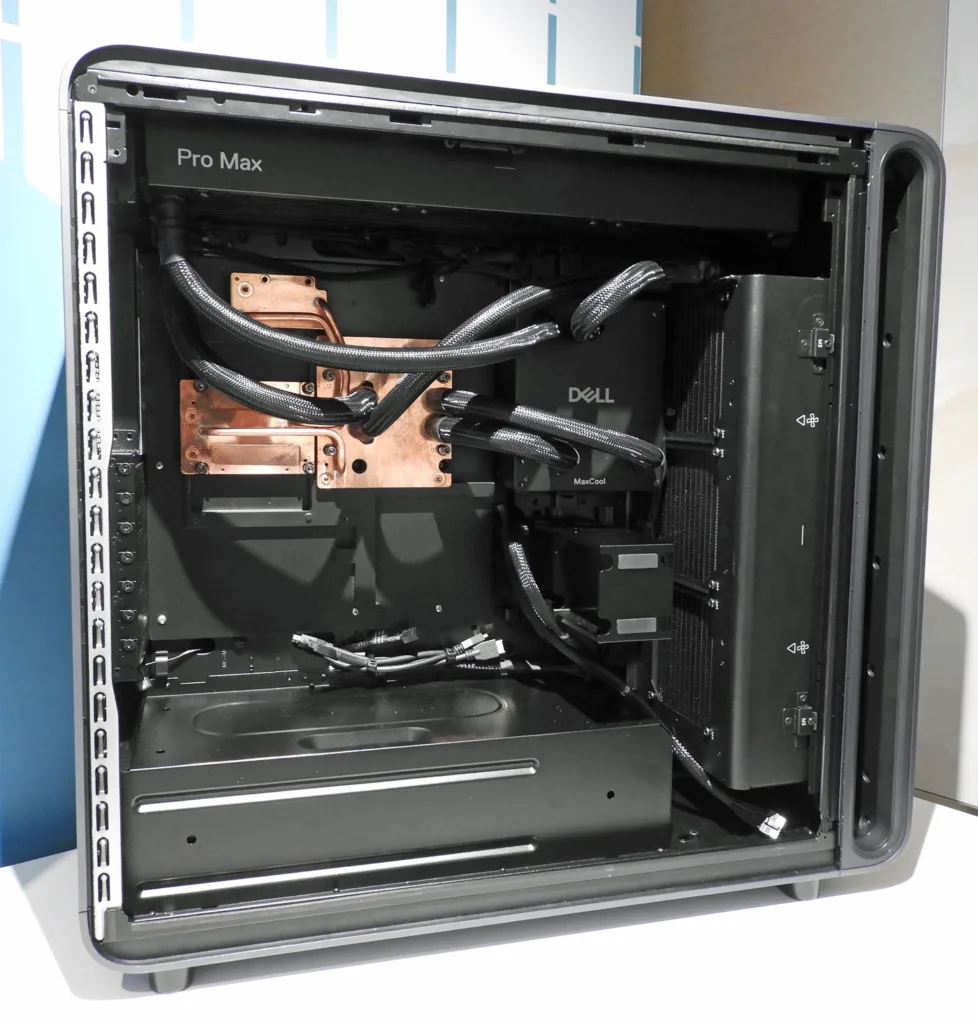
The Dell Pro Max with GB300, shown above, will be an ultra-high-end workstation which was displayed but not announced nor available yet. It will feature the NVIDIA GB300 Grace Blackwell Ultra Desktop Superchip, 496GB LPDDR5X CPU memory, and 288GB HBM3e memory from Blackwell Pro GPUs. It supports up to 1 trillion parameter models, delivering 20 PetaFLOPS of FP4 computing power using the NVIDIA DGXTM OS on Linux & NVIDIA AI Enterprise software stack.
HP
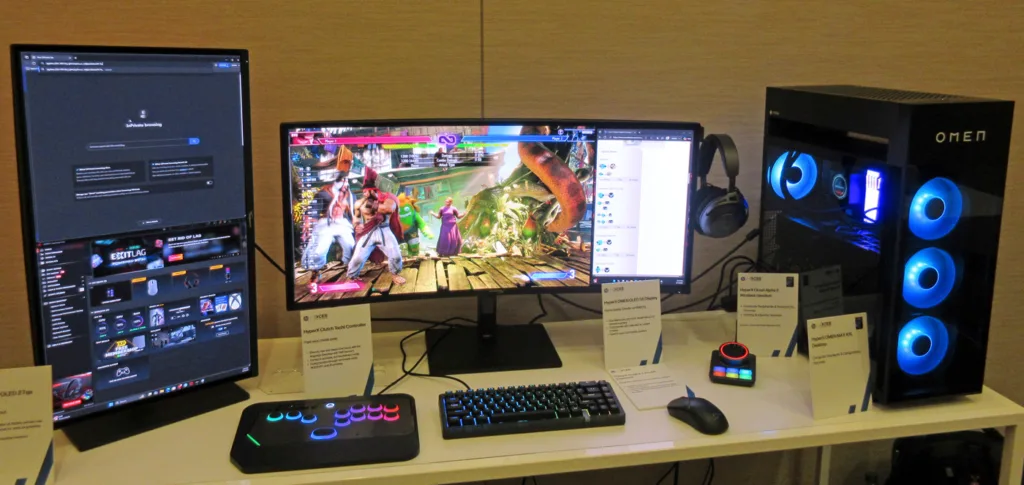
HP may have been primarily known for its workstation, business, and consumer desktops and notebooks, but over the past few years it has expanded into gaming with its OMEN lineup and acquisition of HyperX five years ago from Kingston. This year, HP has consolidated its gaming brand into HyperX OMEN, which was on full display. This includes, desktop PCs, displays, mice, controllers, headsets, keyboards, and several amazing gaming notebooks.
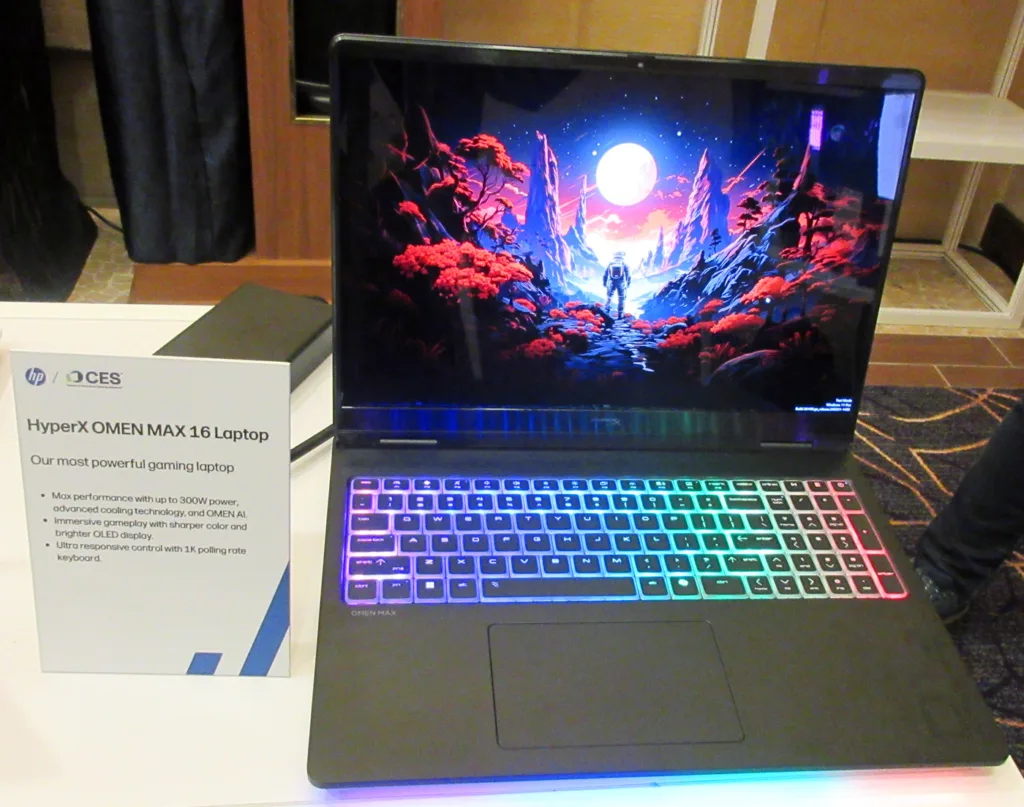
The HyperX OMEN MAX 16 notebook now boasts 300W total power which is 50W more than last year’s flagship model. It boasts a 2.5K OLED 240Hz WQXGA 500-nit OLED display, ultra-responsive 1000Hz polling rate keyboard, and is powered by Intel’s Core Ultra 200HX series or the latest AMD Ryzen AI processors coupled with an RTX 5090. It may be configured with up to 64GB DDR5 6400.
The HyperX OMEN 16 was also introduced with a 200W power envelope with a few compromises such as a 165Hz OLED display, an 800MHz polling rate keyboard, and a Ryzen or Intel CPU paired with an RTX 5070 or RTX 5060.
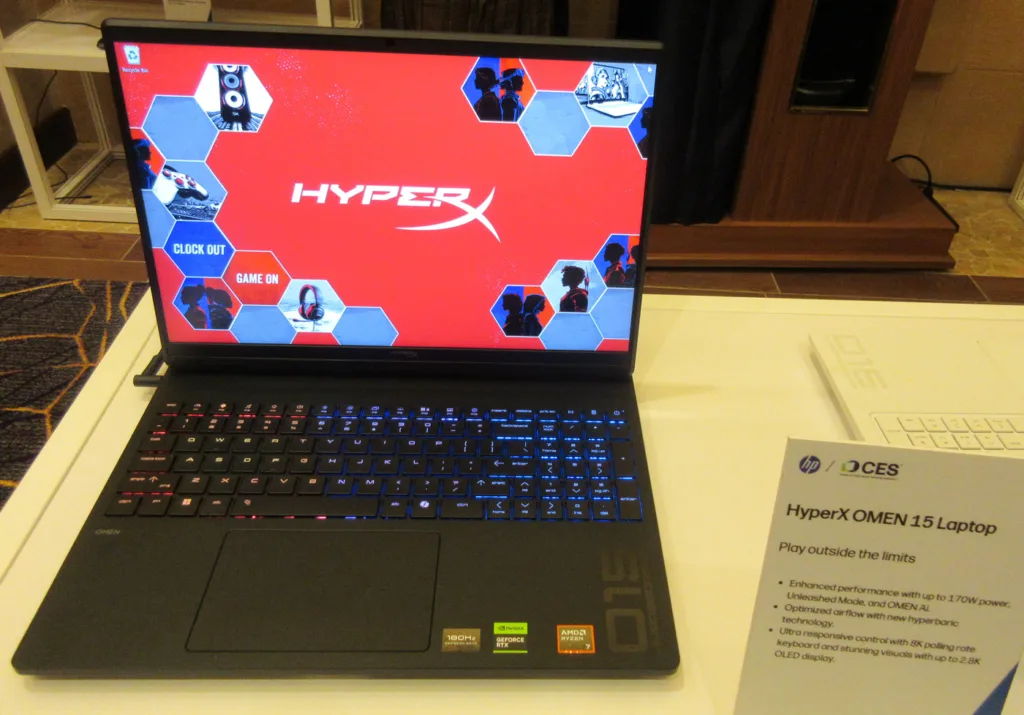
The HyperX OMEN 15 notebook was also introduced for gamers with more modest needs. It offers similar features to its flagship big brother but manages to stay within a 170W power envelope, and features a 120Hz 3K OLED or a higher refresh rate IPS screen. Like the HyperX OMEN 16 (non-Max), a choice of RTX 5070 or RTX 5060 is offered but with an additional less expensive option to use an RTX 5050.
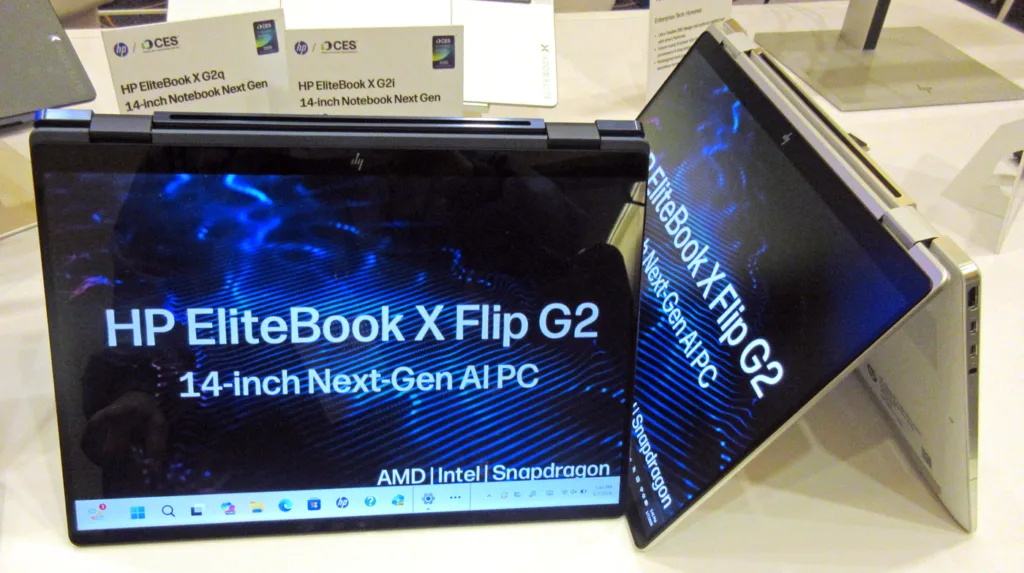
HP also introduced the HP EliteBook X G2 Series, the next generation of premium business AI notebooks, which received a CES 2026 Innovation Award. These Copilot+ PCs combine up to 85 TOPS NPU performance powered by the latest Snapdragon X2 Elite processor with options to use the latest Intel Core Ultra Series 3 or Ryzen AI processors.
These enterprize-grade security-enhanced notebooks are remarkably stylish and light yet easy to service. Most of these notebooks have a special coating to keep fingerprints from smudging them for a continuously clean look.
These notebooks are designed for business and for easy serviceability by an IT department. All the normally replaceable parts are very easy to access, and – unlike with regular notebooks – the keyboard just peels off from the front of the notebook in a few seconds for a keyboard replacement in many languages for deployment to other countries!
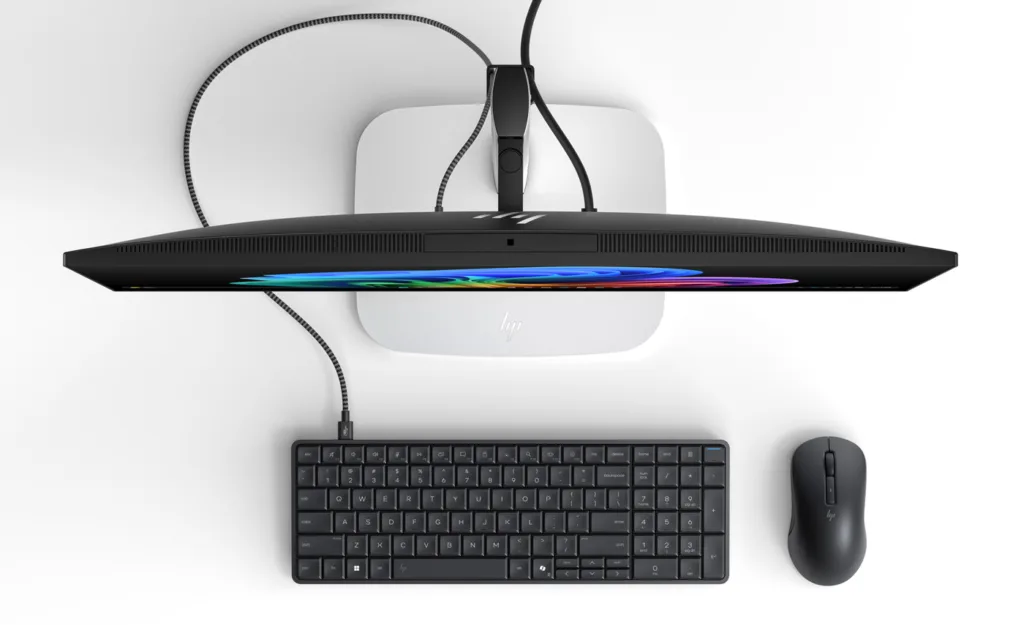
Another winner of the CES 2026 Innovation Award, the HP EliteBoard G1a Next Gen AI PC is the first full AI PC built into a keyboard. Powered by an AMD Ryzen AI 300 Series processor, it delivers 50 TOPS from the NPU with built-in dual mics and speakers at less than half the weight of a small notebook. All you need is a keyboard, mouse, and a display. As with all of HP’s business and workstations, it comes with enhanced Wolf Security. It will be available in March.
HP also unveiled a new series of Omnibooks and Chromebooks, gaming displays, AI-powered printers, accessories, and new software.
Intel
Intel was laser-focused on Panther Lake with integrated Arc Graphics. They launched the Intel Core Ultra Series 3 processors; the first compute platform built on Intel 18A which is the most advanced semiconductor process developed and manufactured in the United States.
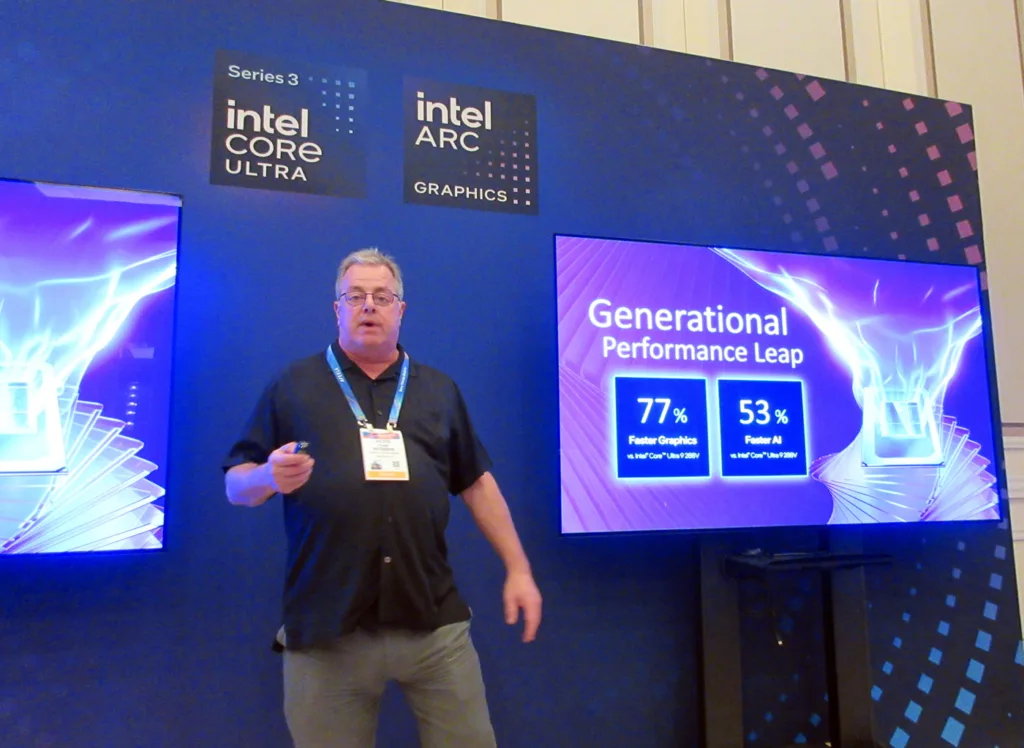
Tom Petersen (TAP) is an almost legendary figure in the PC hardware world where he spent decades at NVIDIA before becoming a spokesperson for Intel and especially for Arc Graphics. His presentation claimed that Intel has made a 77% generational performance leap of Panther Lake’s 12 Xe-core variant of the Arc B390 iGPU over the Lunar Lake Arc 140V graphics using less power.
In addition, the brand-new XeSS 3 software offers 4x multi-frame generation which may well be good enough for many mainstream gamers to ditch their aging desktops instead of paying outrageous prices for discrete GPUs, DDR5 memory, and SSDs to upgrade.
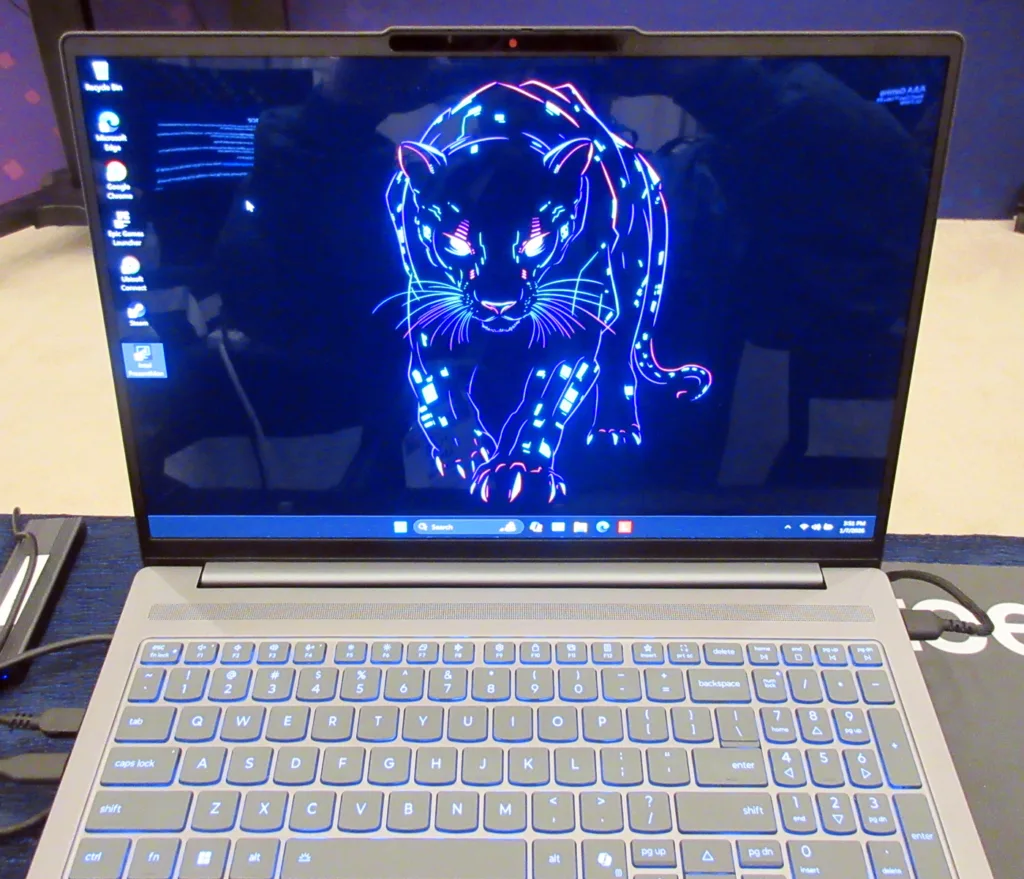
Hands on with a new Panther Lake integrated graphics-powered notebook confirmed that the performance was on a level probably higher than the RTX 4050 discreet mobile solution and just below the RTX 5050, which is very impressive for a low-power chip that may lend itself well to handhelds. In addition, we spent much of our time benchmarking with Intel’s improved PresentMon benching tool which now shows “animation errors” in an effort to convey smoothness.
Intel is focusing on smoothness since path tracing is not practical for any current integrated graphics solution. Stutter has always been a problem. This editor was one of the first to study the multi-GPU SLI and CrossFire frame-pacing issues, and 1% minimums eventually became a standard instead of just using minimum FPS. However, animation errors persist since there is often a mismatch between the position of in-game objects and the time that a player sees them resulting in a visible stutter. We plan to report on this and potentially to incorporate it into our game benchmarks.
In addition, Intel’s Precompiled Shader Distribution will download select Steam game shaders to gamers’ PCs using the Arc Control software suite as Panther Lake becomes available to reviewers before they are available for public use.
Lenovo
Lenovo introduced its latest business devices and solutions designed with AI in mind to update the ThinkPad X1 Aura Edition series, the more performance-focused ThinkPad X9 15p Aura Edition, the impressive ThinkBook Plus Gen 7 Auto Twist, and their new lineup of ThinkCentre X Series desktops.
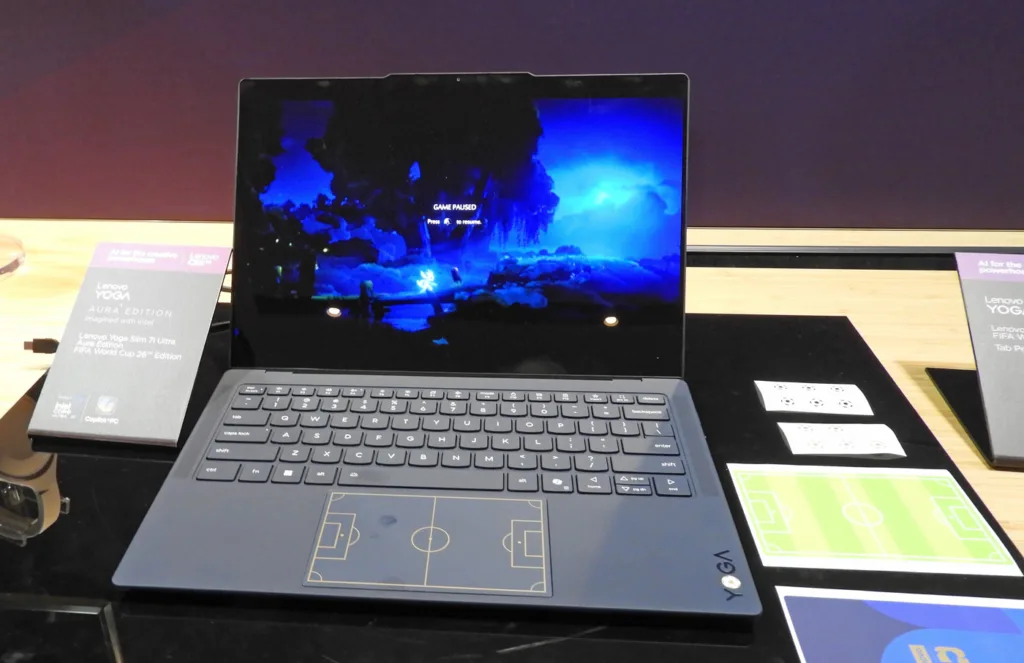
Lenovo has introduced multiple versions of their premium super light and thin (2.15 lbs./0.55-inch thick) YOGA AURA notebooks. The above image is from a partnership with FIFA to introduce a range of FIFA Special Edition devices across multiple device portfolios. These limited-edition models feature exclusive FIFA World Cup 26 branding and packaging for football (soccer) fans.
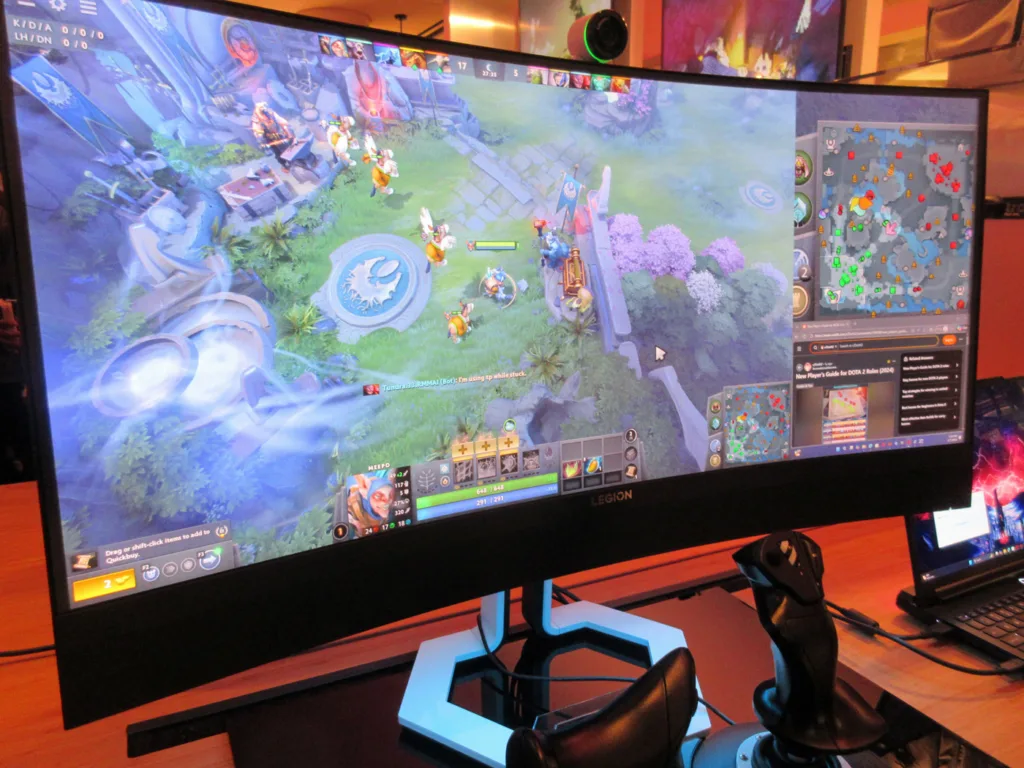
The Lenovo Legion AI Frame Gaming Display is a proof-of-concept smart gaming display featuring built-in AI to enhance gameplay by dynamically zooming in on key areas to provide guidance in real time while offering adaptive lighting. It acts as an AI co-pilot but probably should not be used for competitive play. It is not available for purchase and may never come to market, but it shows what practical AI in gaming is capable of.
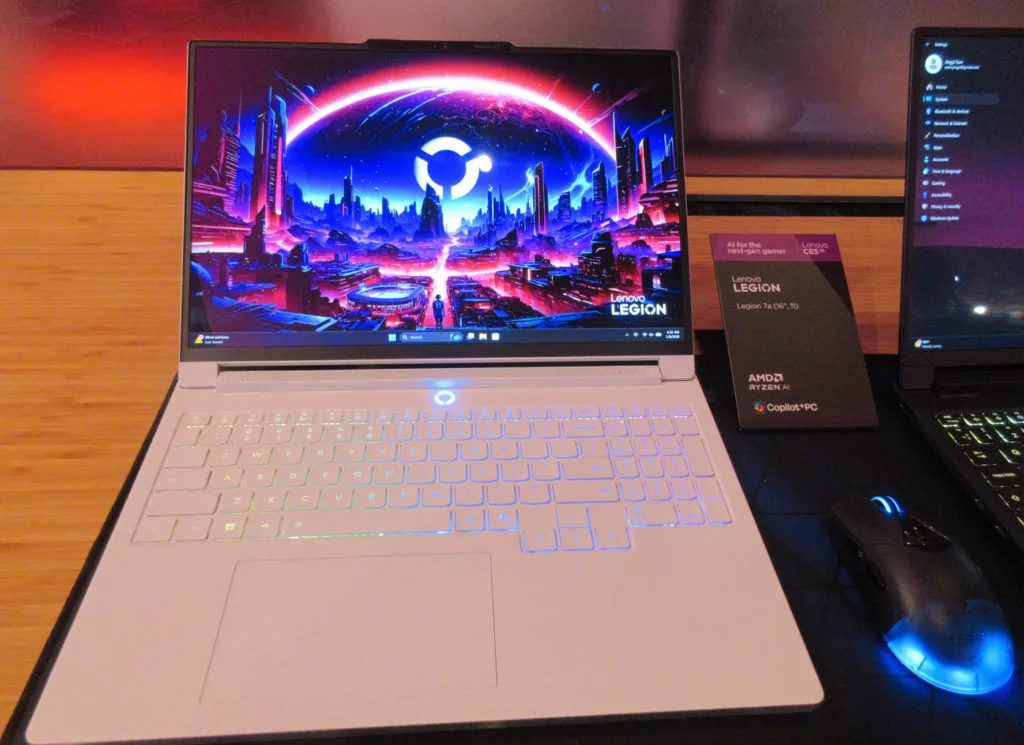
The Lenovo Legion 7a is a very lightweight (4.07 lbs.) 16-inch gaming laptop with an OLED display offering up to a 12-core Ryzen AI 9 HX 470 CPU, an RTX 5060 mobile GPU with a 125 W TDP, 64 GB of DDR5 memory, and 2 TB of storage. The premium G-Sync 16-inch OLED display is 240Hz with 500 nits of brightness.
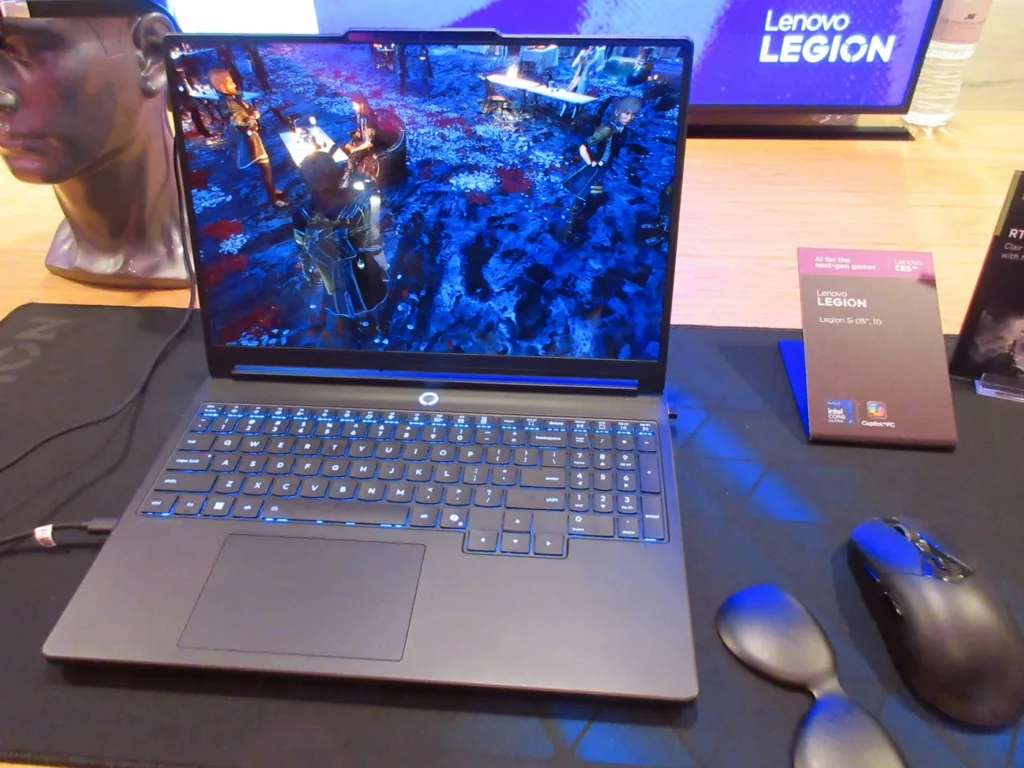
The Legion 5a 15 can be equipped with up to a Ryzen AI 9 465 APU and up to an RTX 5060 laptop GPU. Max RAM and storage are 32 GB DDR5 and 2 TB of PCIe Gen 4, using a 15-inch 1440p OLED display at 165Hz.

Legion Go Generation 2 handhelds with 8.8-inch PureSight OLED screens and accessories were on display. They are finally powered by SteamOS and mobile AMD processors. They are powered by up to an AMD Ryzen Z2 Extreme processor, with up to 32GB LPDDR5X memory, and with up to 2TB PCIe SSD storage with an additional 2TB storage via microSD.
The SteamOS-powered Go won’t be available until June. Mobile gamers should start saving up as it will start at $1119.
The Legion Pro Rollable Concept is a 16-inch top-tier gaming notebook with a rolling screen that expands horizontally from 16-inches to 21.5-inches to 24-inches. Although it was shown as a proof of concept, we were assured that it will be coming to market, probably in the latter half of 2026.
The ThinkBook Plus Gen 7 Auto Twist swivels so that the screen is facing you at all times. It is perfect for creators and presentations when the user walks about.
It can even respond to gestures and voice commands, and it will be available in June.
MSI
MSI (Micro-Star International) makes a wide range of high-performance computer hardware and is primarily known for its gaming and creator products. These include notebook and desktop PCs, motherboards, graphics cards, as well as displays and peripherals. In addition, MSI makes industrial PCs, servers, automotive infotainment systems, and software, as well as AI solutions.
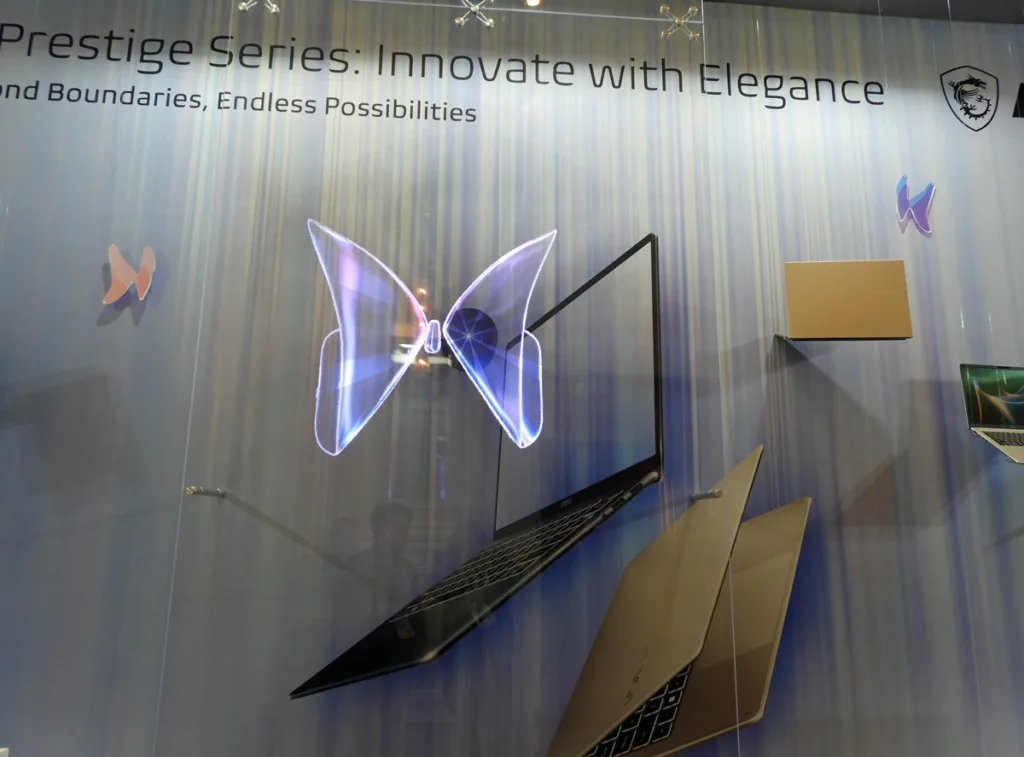
MSI has chosen as a symbol, a stylized butterfly which was prominently displayed at CES 2026.
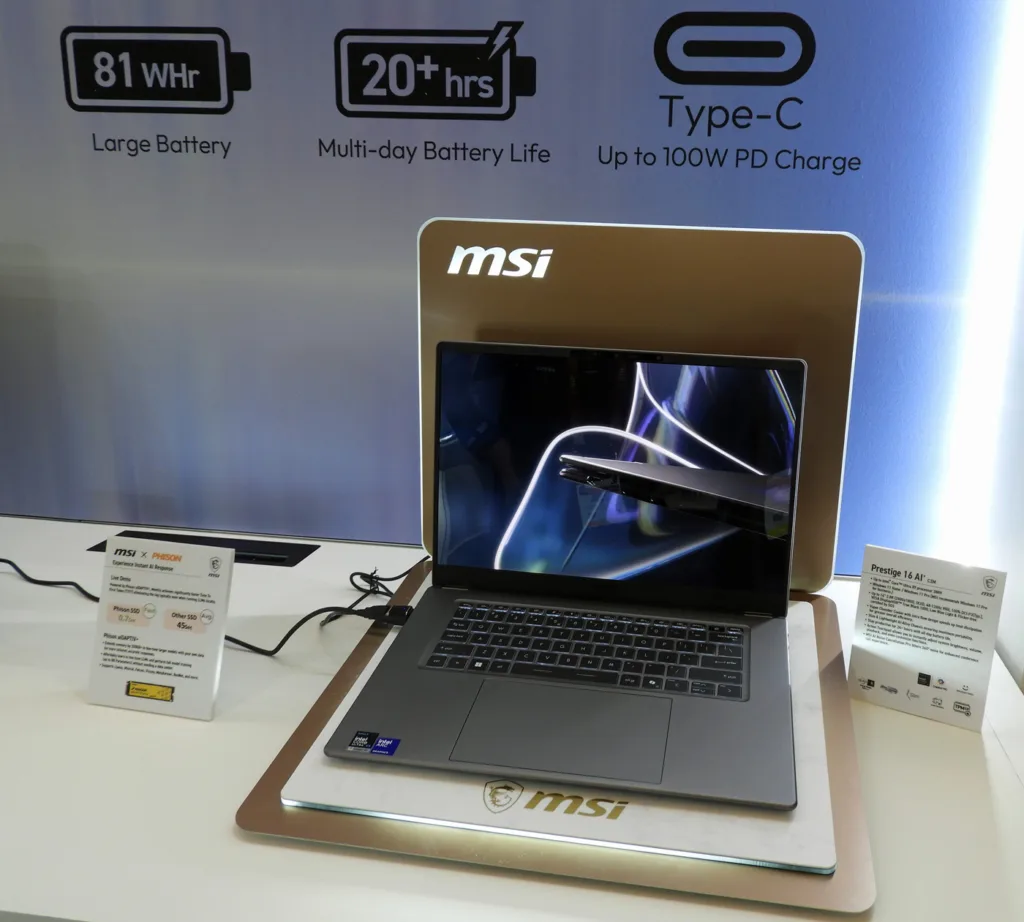
We found this particularly interesting when checking out the Prestige 16 AI notebook, that MSI had formed a partnership with Phison to expand capabilities for its aiDAPTIV+ technology that extends powerful AI processing to iGPU architectures.
This aiDAPTIV+ architecture now accelerates inference, increases memory capacity, and simplifies deployment to unlock and speed up large local model AI capabilities on notebook, desktop, and mini-PCs with limited VRAM. Increasing memory capacity is something we are interested in as otherwise SSDs are much too slow.
This looks to be a very capable notebook that may even be able to handle local large language models besides its flexibility that allows it to double as a tablet.
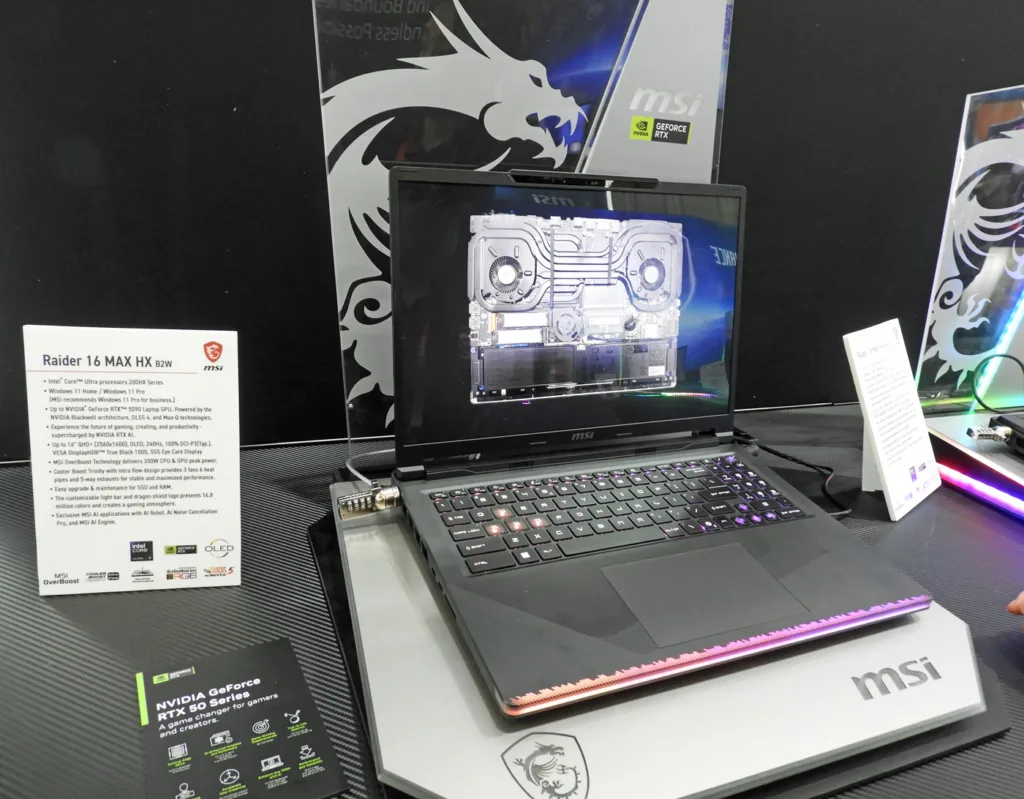
This is the latest Intel powered 16-inch 1440P 265Hz version of the flagship AMD 16 core 4K 18″ MSI Raider A18 HX A9WJG-052US that we reviewed. It also has a mobile RTX 5090 within a 300 W total power envelope with three fans and six heatpipes cool it.
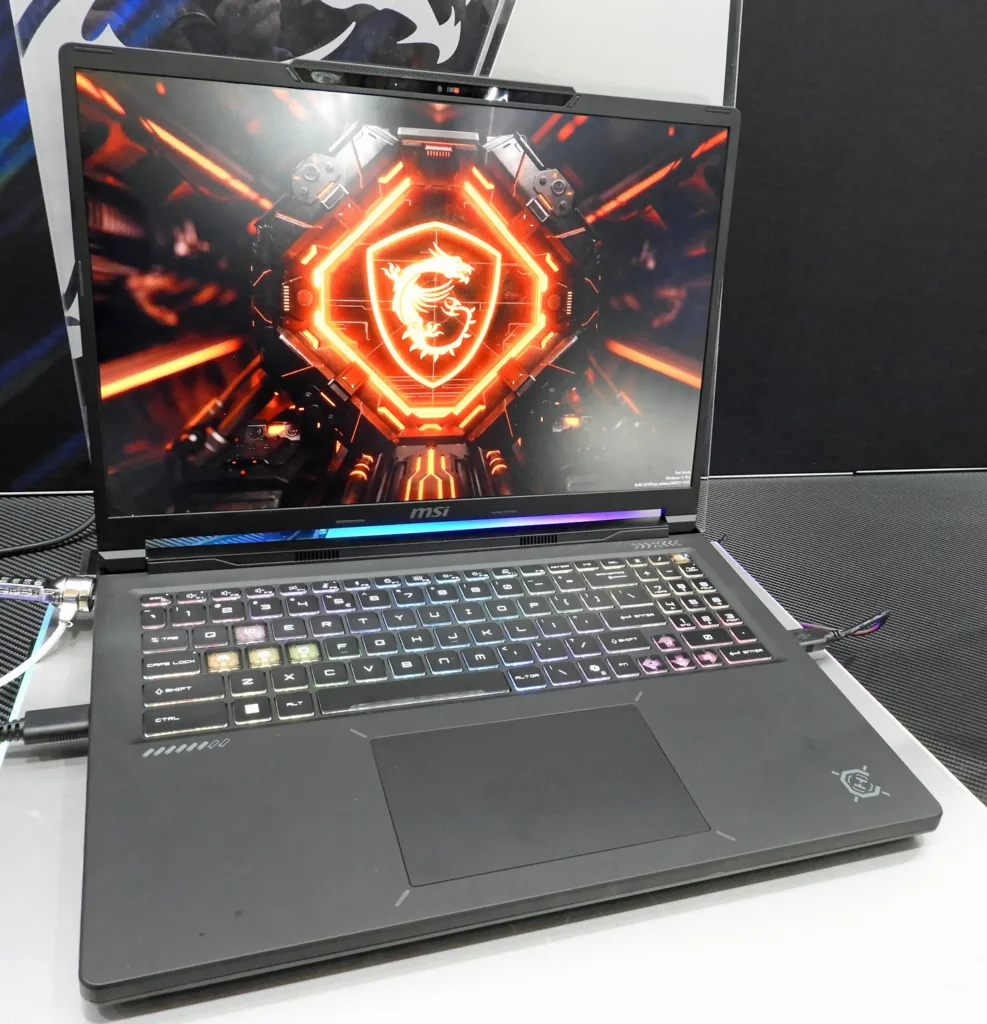
Stepping down a little into a 200 W power envelope, but using a similar 1440p OLED 165Hz display, is the Crosshair 16 MAX HX that uses an RTX 5070 with two cooling fans and 5 heatpipes.
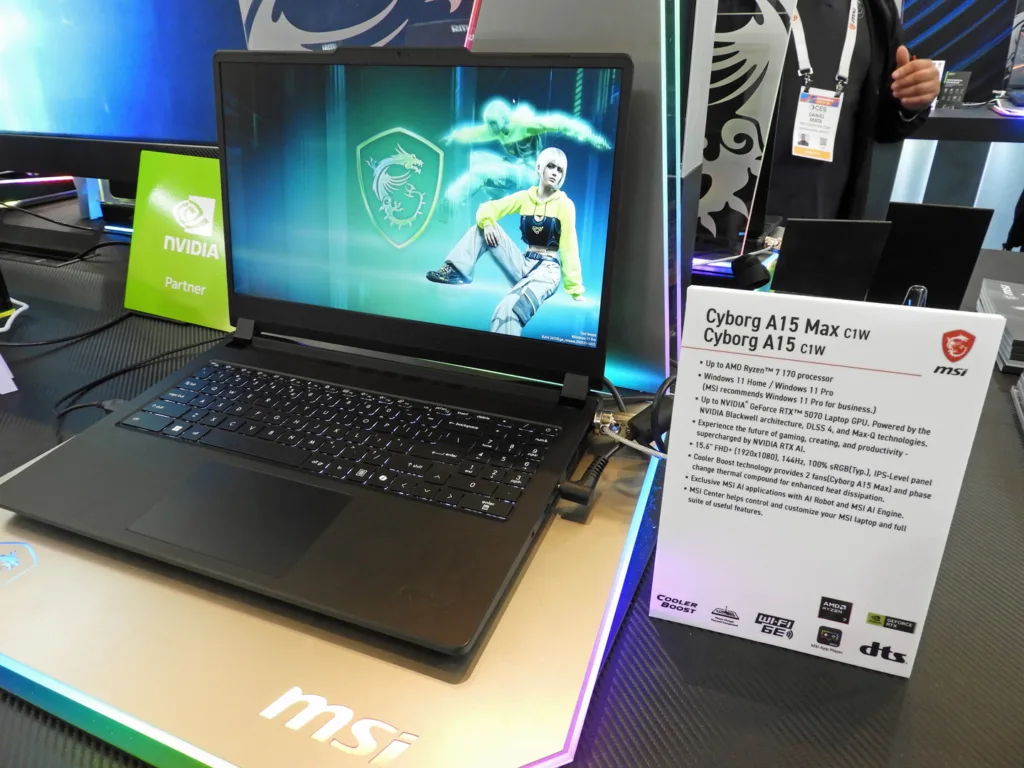
Moving down the notebook lineup, we reached the Cyborg A15 and A15 Max. They are still quite powerful, using a mobile RTX 5070, but the displays use 1080p IPS panels at 144Hz, and use two cooling fans.
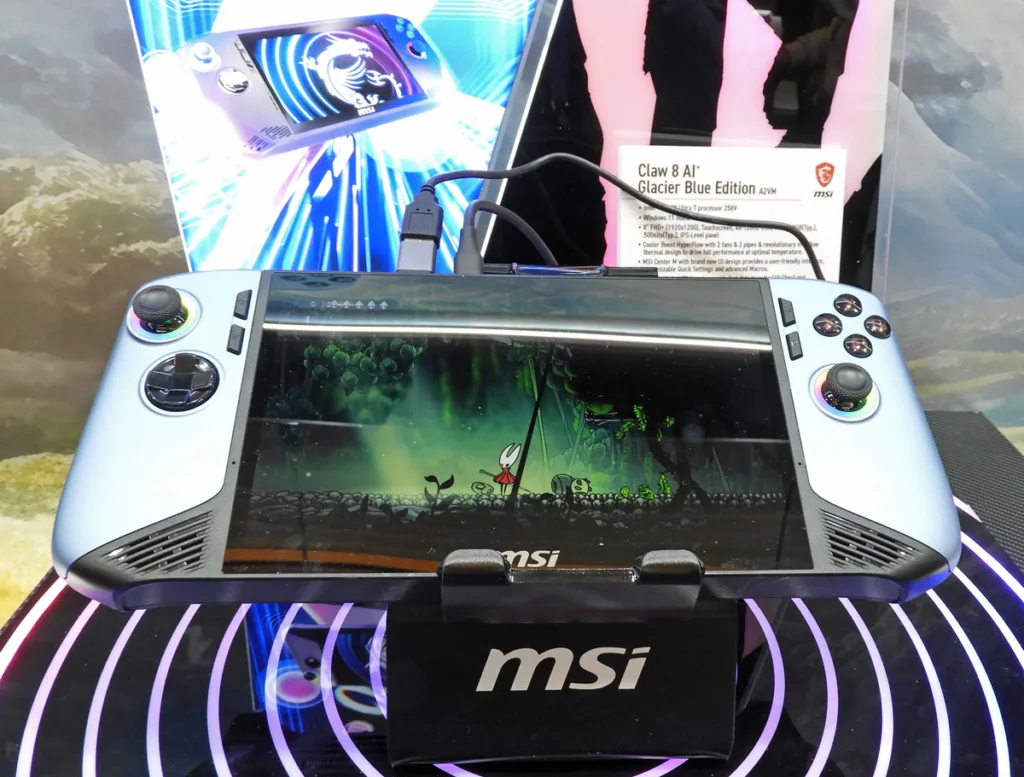
We really liked the MSI Claw 8 AI+ in the new Glacier Blue color. It features an 8-inch 1080p touchscreen IPS display, an Intel Core Ultra 7 258V with integrated Intel Arc 140V graphics, 32GB RAM, and a 1TB SSD.
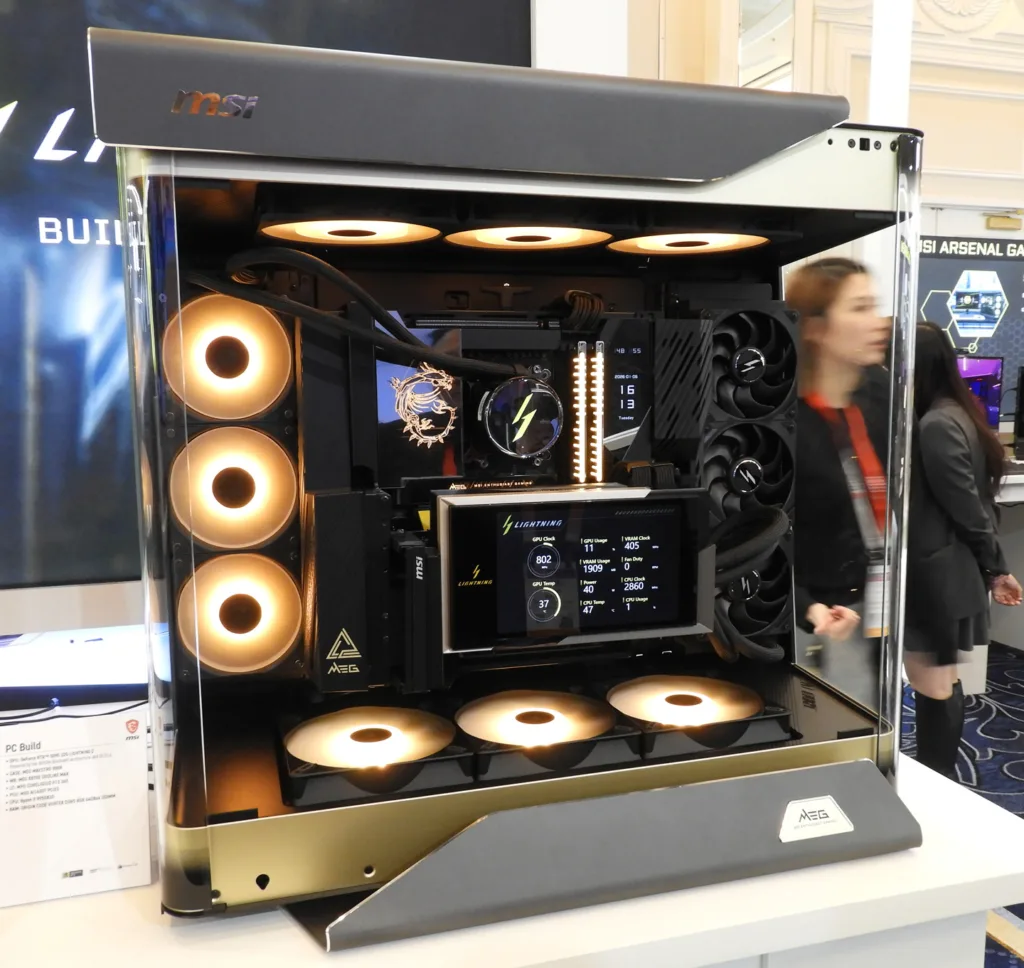
We could not help but be impressed by the new RTX 5090 Lightning Z. It features the world’s first 8-Inch GPU display, the first GPU to reach 1000W, and the first full-copper, full-cover cold plate for extreme overclockers. There will only be 1,300 produced, each selling for nearly $5,100.
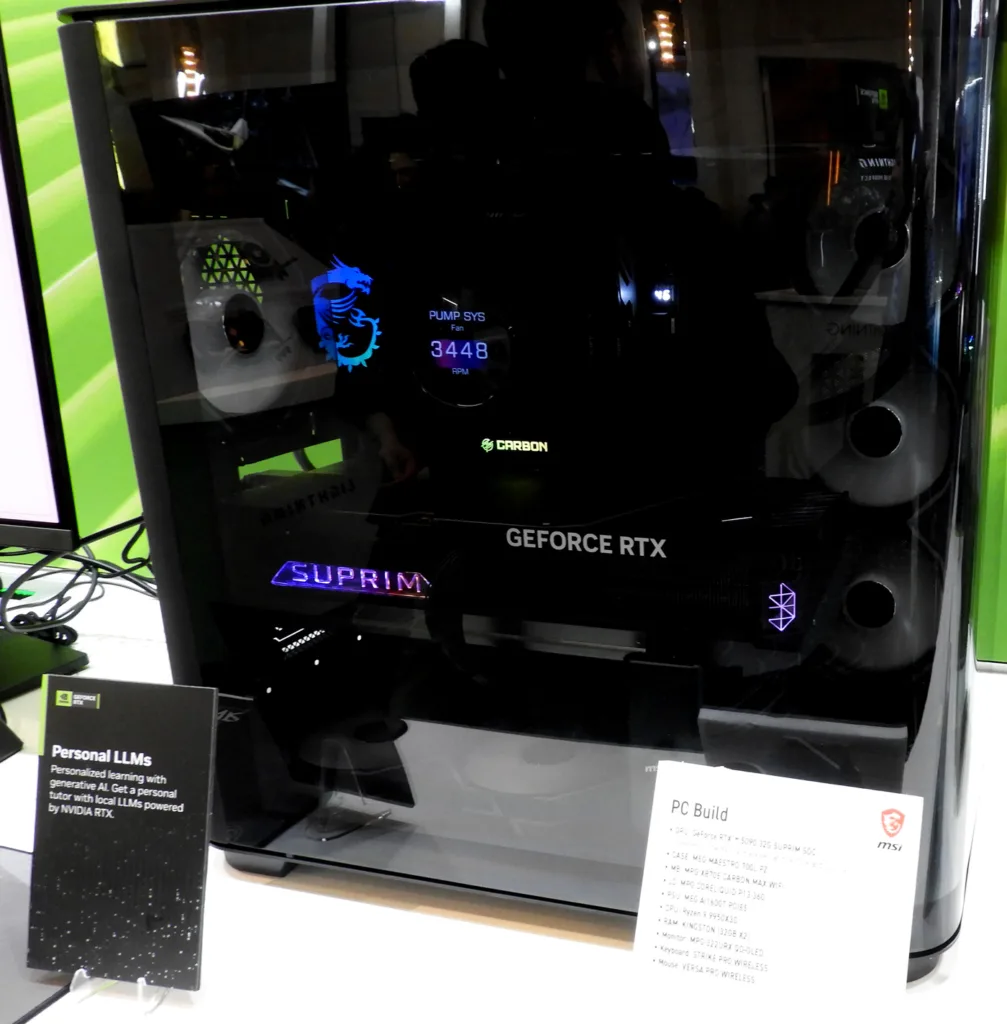
We are reminded that PC builds featuring an RTX 5090 are not only for gaming but are able to run local LLMs efficiently.
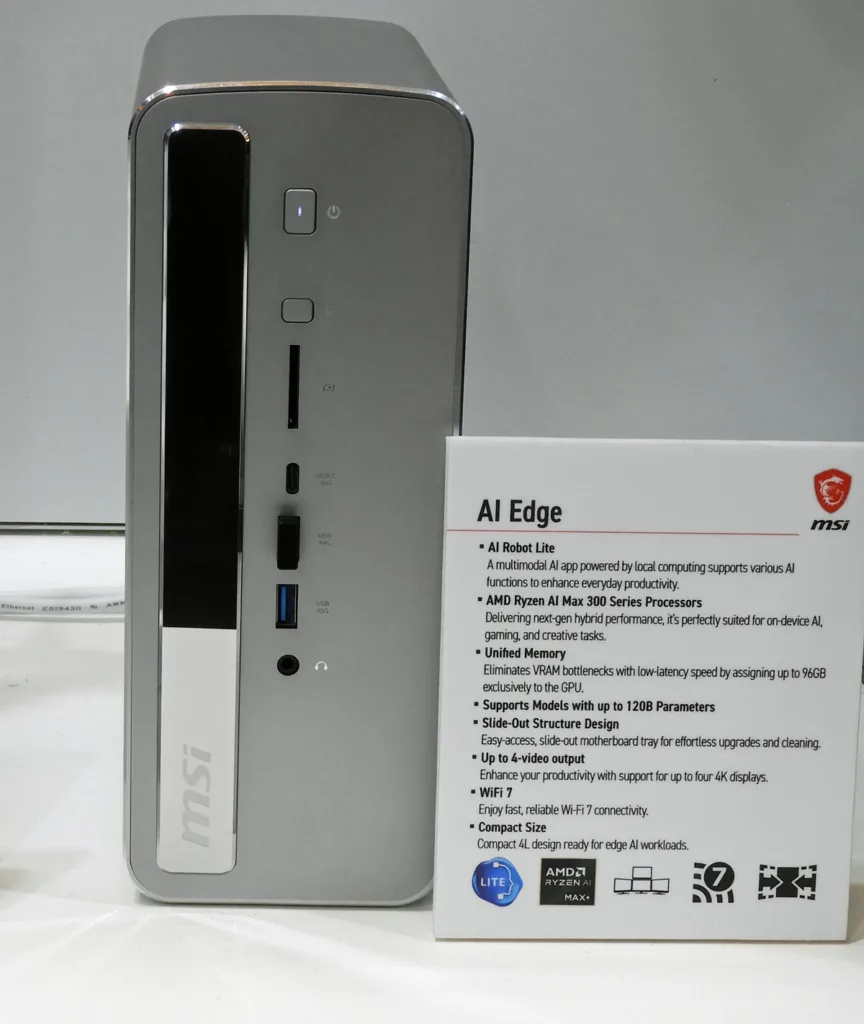
The compact MSI AI Edge uses AMD’s Strix Halo to run up to 120 billion parameter LLMs using its shared memory of 128GB to assign up to 96GB to the GPU.
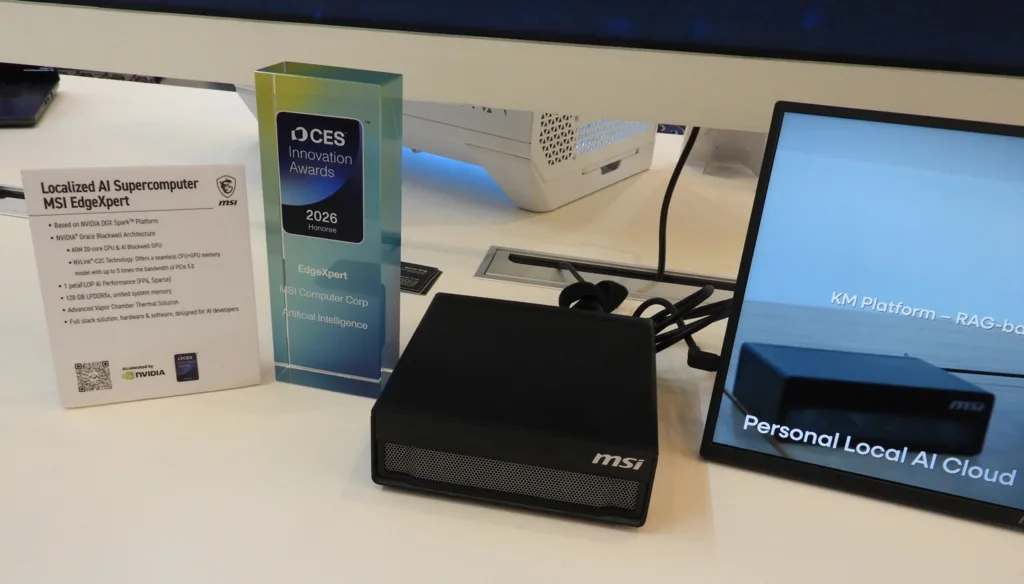
MSI’s EdgeXpert is basically a DGX Spark dev kit. However, their innovative advanced vapor chamber thermal solution, which eliminates the throttling found in the reference version, won them a CES 2026 Innovation Award
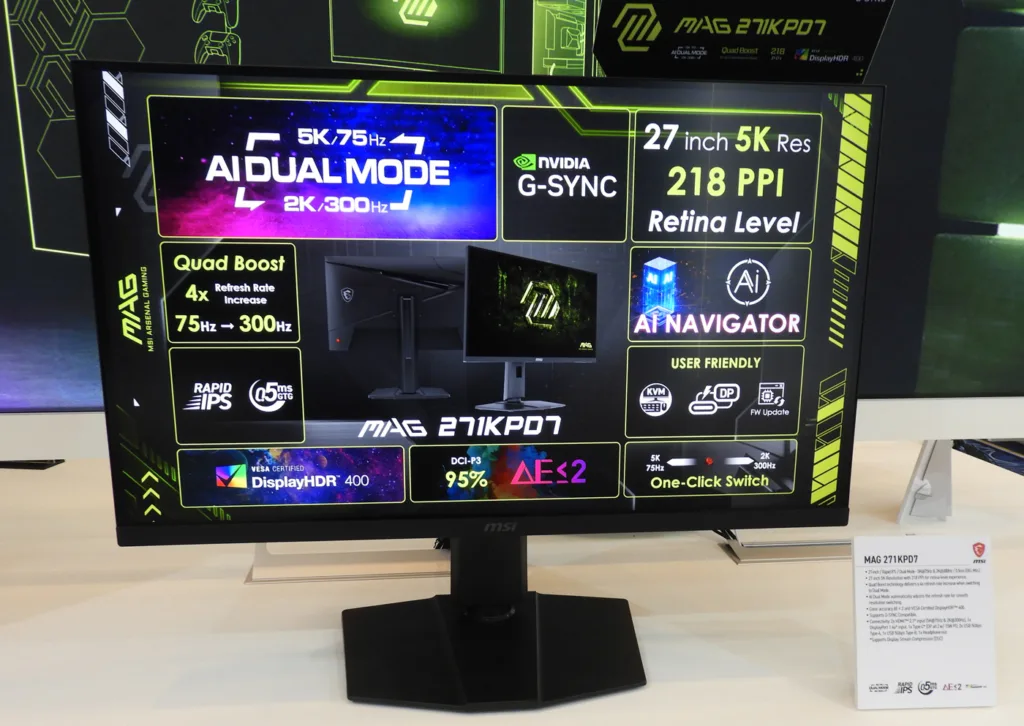
The brand-new 27-inch Rapid IPS dual mode gaming display is capable of switching between 5K at 75Hz and 1440p at 300Hz. It boasts a 0.5ms GtG response time, and 218 pixels per inch with outstanding clarity. It offers 2x HDMI 2.1 inputs, 1x DisplayPort 1.4a, 1x USB-C Type-C, 2x USB Type-A ports, 1x USB-B, and 1x headphone jack for outstanding connectivity.
The flagship 271KRAW16 (not pictured) is capable of switching between 5K at 165Hz or 2K at 330Hz plus a Mini-LED backlight with 2,304 zones, along with Quantum Dot technology.
NVIDIA
NVIDIA also exhibited off-CES using an entire floor of the Fontainebleau hotel. We could have spent literally days exploring all the exhibits but were limited to two hours with NVIDIA’s representatives as they demoed what is new in GeForce gaming.
As expected, AI is becoming more and more featured in gaming besides its current use for upscaling with the new DLSS 4.5.

Instead of playing with predictable and boring ‘bots, NVIDIA is offering voice commands using ACE for AI-powered teammates that are really helpful as the demo below demonstrates.
The second demo used Total War: Pharoah, a very different and complex game, that presents a relatively steep learning curve to gamers new to the Total War series.
We applaud these efforts realizing that this is just the beginning of AI in gaming. We look forward to the day when AI-controlled NPCs talk to us directly in natural language and remember our actions, particularly in RPGs.
The following demo explains NVIDIA’s G-Sync Pulsar technology.
G-Sync Pulsar brings a new set of features to esports displays in search of perfection in motion clarity. These Pulsar-certified panels must be 27 inches at 1440p with 360Hz refresh rates to achieve 1000Hz+ “perceived motion clarity with VRR.” In addition, Nvidia’s G-Sync Variable Overdrive and new Ambient Adaptive Technology features are required. Acer, AOC, ASUS, and MSI already have these panels ready.
The following demo covers NVIDIA’s Remix upgrade which is already a fantastic tool for modders.
Remix gives amazing tools to modders who will be now able to achieve AAA-type game results using AI.
G-Assist is somewhat similar to the game (and creator) AI that CORSAIR demonstrated using voice with its iCUE software with G-Assist.
GeForce NOW has finally come to Linux gamers, specifically starting with Ubuntu version 24.04. It will likely come to other Linux distros in time.
We look forward to setting up our own Linux distro on our own PC to compare performance with Windows 11 gaming.
Finally, we look at the DGX Spark demo.
The speedup is incredible over by just using the MacBook. To professionals, time is money and the DGX Spark provides the AI hardware for completing a task many times faster.
Final Thoughts
We really appreciate the time and effort that AMD, CORSAIR, Dell, HP, Intel, Lenovo, MSI, and NVIDIA representatives spent with us explaining and demoing their new hardware and software at CES 2026. These are exciting times for gamers, creators, and professionals as AI begins to show practical uses that will impact our daily lives for work and play.
We made new contacts, met old friends and contacts, and reaffirmed our own commitment at BTR to providing the best reviews possible for our readers. Stay tuned as we review some of these new and exciting products we previewed at CES! Expect at least one brand new in-depth hardware product review by the end of this month.